For three years I wrapped tumblers by hand. I still have the first one, a blank with a seam down the side where the transfer overlapped itself and a pale band near the base where my tape slipped overnight. Glen keeps his pens in it. It sits on the shelf in the press room as a reminder of how much of this craft used to be tape, patience, and hoping.
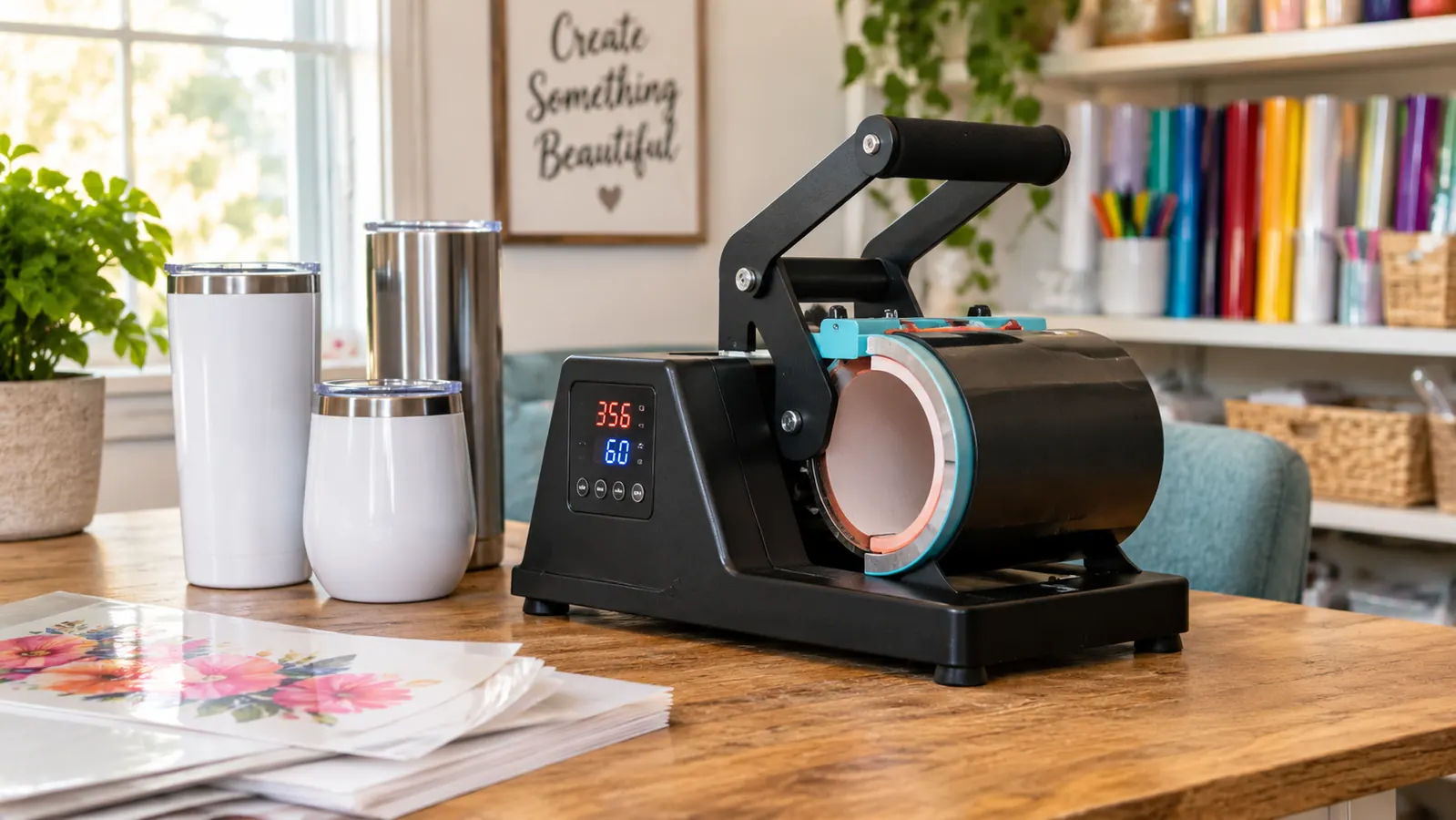
Hand wrapping works. That is not the argument here. The argument is what it costs you in evenings, tape, and ruined blanks. A tumbler heat press applies even pressure around the whole circumference instead of asking your fingers to do it, and after four years and a few hundred orders out of a converted spare bedroom, I would not go back. The machine on my bench is the HTVRONT Auto Tumbler Heat Press. Here are the ten reasons I would give a friend standing in my kitchen asking whether it earns its shelf space.
The press that ended my tape-at-midnight era
The HTVRONT Auto Tumbler Heat Press fits 10 to 30 oz drinkware, runs 210 to 390 °F, and carries a one year warranty.
Amazon Check Today's Price on Amazon →Load it, click it, and get your hands back for the next blank
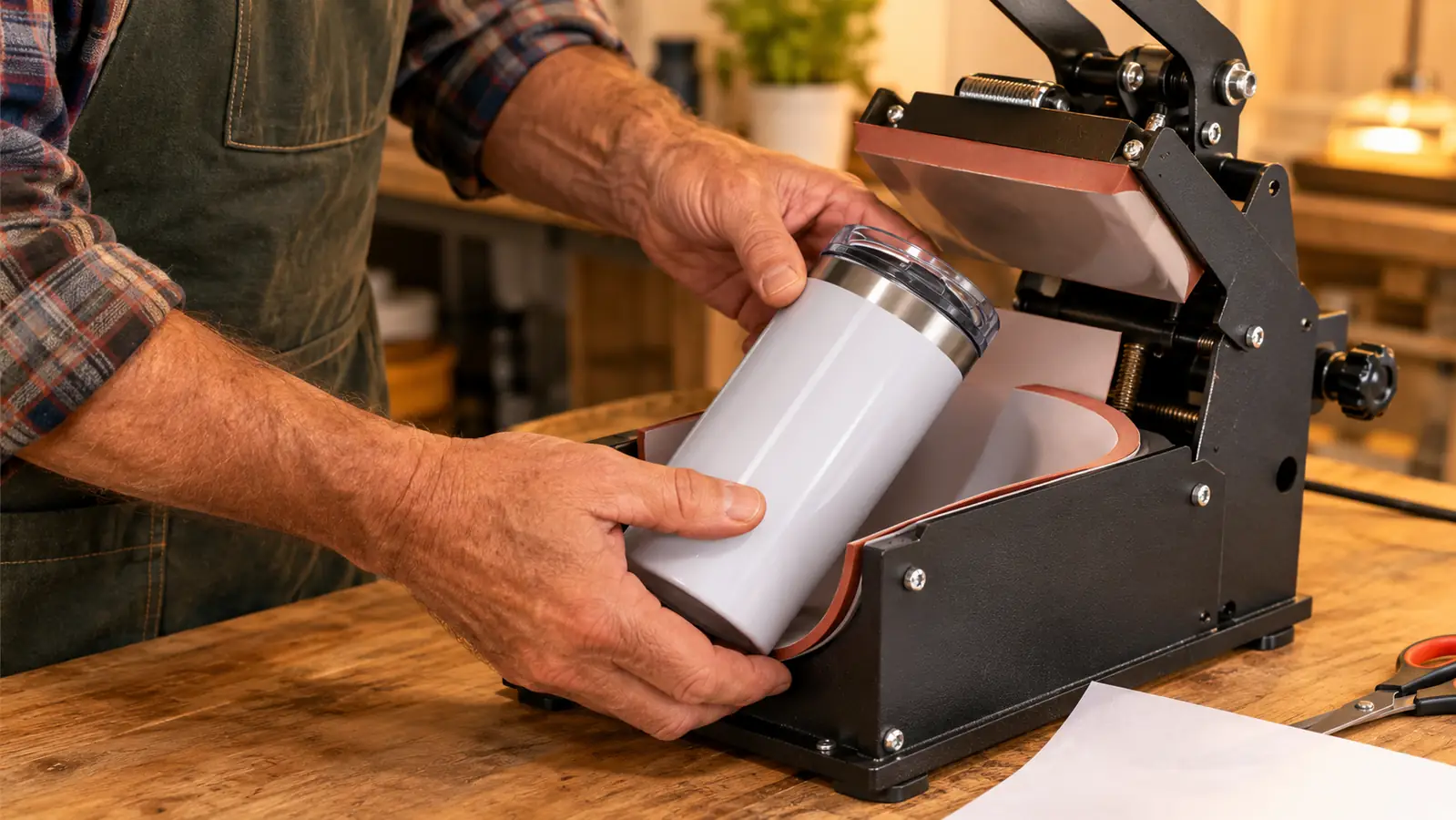
The first evening I used it, I kept hovering. There is nothing to hold, nothing to re-tape, nothing to check every ninety seconds. You set the tumbler in, the heat pad closes around it with a click, and you walk away to trim the next transfer. I finished a set of six teacher tumblers while dinner was in the oven. With wraps I would have been on tumbler three and Glen would have been reheating his own plate.
No overlap ridge running down the side of your design
A hand wrap has to overlap itself somewhere. You can trim it, burnish it, and on a good day hide it at the back. On a bad day it shows up in the finished print as a faint ridge with a lighter line above it. The press pushes evenly around the whole circumference, so there is no overlap because there is no wrap. The booster club mugs come off with a continuous print the whole way around, and I stopped dreading the designs that wrap fully.
One machine covers 10 oz to 30 oz, which is most of what actually sells
This HTVRONT press accommodates tumblers 2.9 inches to 3.2 inches in diameter, from 280 ml to 850 ml, so 10 oz up to 30 oz. That is the range I actually sell into: the skinny 20 oz tumblers, the standard 20 oz, and the 30 oz ones the youth teams ask for. I keep a cheap pair of calipers in the drawer and measure anything new before it goes near the press, because a blank that falls outside that window is a blank that will not sit right.
The R button is a real panic button, not a marketing line
Press R and the machine halts heating and releases the heat pad instantly. I have used it twice for real and both times it saved a blank I had already spent twenty minutes on. The second time was a tumbler where the transfer had shifted and I caught it too late. With a hand wrap you are peeling tape off a hot blank with your fingertips and hoping. With this you press one button and the pressure is gone.
210 to 390 °F covers every drinkware blank I actually buy
The machine runs from 210 °F up to 390 °F. Most of my work sits in the middle of that range, and the top end matters for the blanks that need a hotter press to fully release the transfer. The bottom end matters more than people expect, because a coated blank pushed too hot goes dull and slightly yellow and there is no fixing it afterward. Having the full range on the display means I stop guessing.
It fits on a shelf in a converted spare bedroom
At 12.9 inches long, 10.9 wide, and 6.3 tall, and 4.92 kg, the HTVRONT machine lives on the end of my worktable and still leaves room to lay out transfers. My press room is a spare bedroom, not a workshop. The oven method takes over the kitchen for an afternoon. This takes up less counter than the kettle. If your space is a corner of a room you also use for something else, that difference decides the whole purchase.
Twenty of the same thing stops being a two evening job
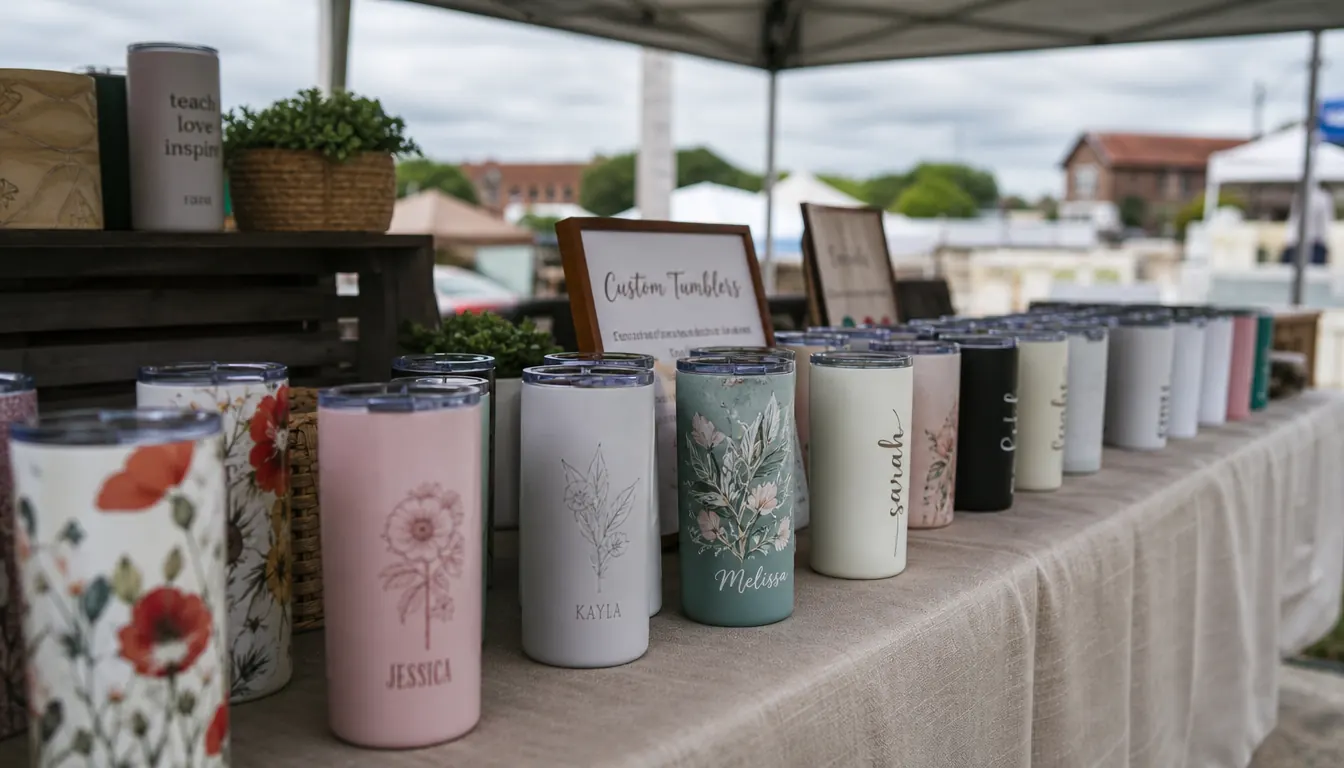
A set of twenty travel tumblers for a soccer team used to take me two evenings with wraps, because the wrapping is the slow part, not the pressing. Same setting, same pressure, one blank after another, and the whole batch is on the drying shelf before the light changes. Repeatability is the thing that quietly makes custom orders possible. If the twentieth tumbler looks like the first, you can say yes to bigger jobs.
Fewer ruined blanks, which is where the budget quietly goes
Every wrap that slips costs a blank, and blanks are the part of this craft that adds up fastest. A slipped wrap means reprinting the transfer, re-prepping the surface, and starting over. I ruined nine blanks in my last year of hand wrapping and one in my first year with the press, and the one was my own fault for not checking that the transfer was flat. Fewer do-overs is the least glamorous reason on this list and probably the most practical.
Curved drinkware stops being the hard part of the job
Sublimation on drinkware is exactly what this machine is built for, and curved surfaces are where hand wrapping gets fussy, because the wrap wants to pull and the tape wants to lift at the seam. Once the pressing is handled, the work that is left is the design and the customer conversation. That is the part I actually enjoy. The mechanical part, the part that used to eat my evenings, is now the fastest step in the process.
600 watts, a one year warranty, and no real learning curve
The HTVRONT unit draws 600 watts at 120 volts, the shell is ABS and wipes clean with a damp cloth, and it carries a one year warranty. I had it pressing correctly on the first evening, which I cannot say about the first wrap I ever did. There is no tension to learn, no tape angle to master, no guesswork about whether the pressure is even. You set the temperature, you set the tumbler, you press the button.
What I'd Skip
Skip the extra mug attachments until you have paid orders that need them. I bought a mug setup in my first month with the HTVRONT press because it looked like the obvious next step, and it sat in the drawer for a year while I pressed tumblers. Buy the tool when the job shows up, not before. The same goes for a second machine. One press, one person, one press room is plenty until you are genuinely turning work away.
The first tumbler I wrapped by hand had a seam you could find in the dark. The first one off the press had nothing to find at all.
If you are still taping wraps at midnight, this is the upgrade I would make first
Start with the machine that does the pressing for you, then add attachments as the orders actually ask for them.
Amazon Check Today's Price on Amazon →