Short answer first: if you are pressing tumblers for anyone other than yourself, the HTVRONT Auto Tumbler Heat Press Machine is the better tool, and it is not a close call. The press clamps with the same pressure on the first tumbler and the fortieth. The oven wrap method depends on how steady your hands were at seven in the morning and how tight you happened to pull the tape. If you are pressing two mugs a year for your own cupboard, though, an oven and a pack of shrink sleeves will still get you a clean result, and you will learn more about sublimation in one weekend than you would from a month of videos.
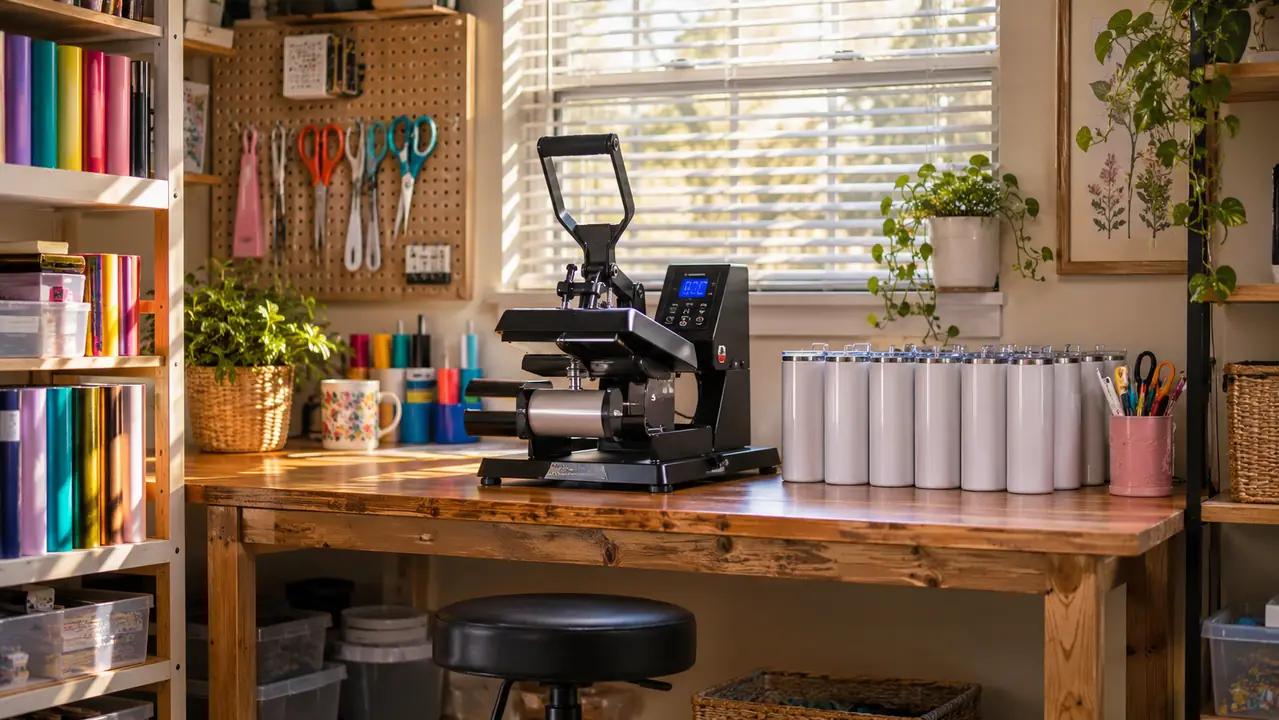
I know both sides of this because I did it the hard way first. Four years ago I made matching shirts for a family reunion and that was the end of my quiet evenings. Now I run a small heat press and sublimation business out of the spare bedroom in our house in Vancouver, Washington. I call it the press room, because calling it the spare bedroom makes it sound like there is still a guest bed in there. Glen loads the car for weekend craft fairs. I take custom orders and press for a couple of local booster clubs and youth teams, all of it in that one room, and I have scorched enough blanks to have opinions worth listening to.
| HTVRONT Auto Tumbler Heat Press | Oven Wrap Method | |
|---|---|---|
| Setup for each blank | Set the temperature, load the blank, click it closed. Nothing to tape or sleeve. | Print, wrap, tape the seam, slide on a sleeve, shrink it, then load the oven. |
| Pressure on the paper | The heat pad clamps the same way every time. | As tight as you managed to wrap it that particular day. |
| Heat control | Holds any set temperature from 210 to 390 °F. | Swings, and drops every time you open the door to load or unload. |
| Blank range | Tumblers 2.9 to 3.2 inches across, 10 to 30 oz. | Anything that fits on a rack, including wide steins and handled mugs. |
| Batch size | One tumbler at a time. | A full rack at once. |
| Getting the blank out | Press the R button and the heat pad releases instantly. | Mitts, tongs, and a hot vessel at eye level. |
| Cleanup | Nothing to unwrap. | Paper, tape and a spent sleeve per mug. |
| What you need to start | One machine and a free outlet. | The oven you already own, plus sleeves and a heat gun. |
| Learning curve | An afternoon, mostly spent learning temperatures. | A few ruined blanks before wrap tension finally clicks. |
| Best for | Repeat orders where every print has to match the sample. | Testing the water and pressing odd-shaped drinkware. |
How the Oven Wrap Method Actually Works
For anyone who has not tried it, the oven method is exactly what it sounds like. You print your design, wrap the sublimation paper tight around the tumbler, tape the seam so it cannot shift, slide a shrink sleeve over the whole thing, and run a heat gun across the sleeve until it pulls in tight. Then the blank goes into a preheated oven for a set number of minutes. You pull it out, and you unwrap it while it is still hot enough to matter.
The results can be genuinely beautiful. I still have a 15 oz mug from my first month that is the cleanest print I have ever pulled, sharp at the seam, no ghosting, no fade. The problem is that I could not tell you exactly why that one worked. My wrap tension was right that day, the oven had been running for an hour, and I got lucky. Ask me to repeat it twenty times for a team order and the run starts drifting. One blank comes out slightly light at the seam because the paper lifted a hair. Another picks up a faint shadow where the sleeve folded over itself.
The first big order I ever took was eighteen mugs for a booster club in October of my first year, and I wrapped every one of them by hand on the kitchen counter over two evenings. I ran them through the oven in two racks and unwrapped them on a towel because the counter was too hot to work on. Six of the eighteen had a faint line at the seam where the paper had shifted a fraction under the sleeve. Not one customer complained, because from arm's length you could not see it. I could see it, and I still think about that order when somebody asks whether the wrap method is good enough.
Then there is the part nobody puts in the tutorial. You are reaching into a hot oven with mitts on, at eye level, holding a metal vessel with a shrink sleeve on it. Every single time, for every single mug. I have a small scar on my forearm that I can point to when people ask whether the oven method is really that bad. I was being careful.
Where the HTVRONT Tumbler Press Wins
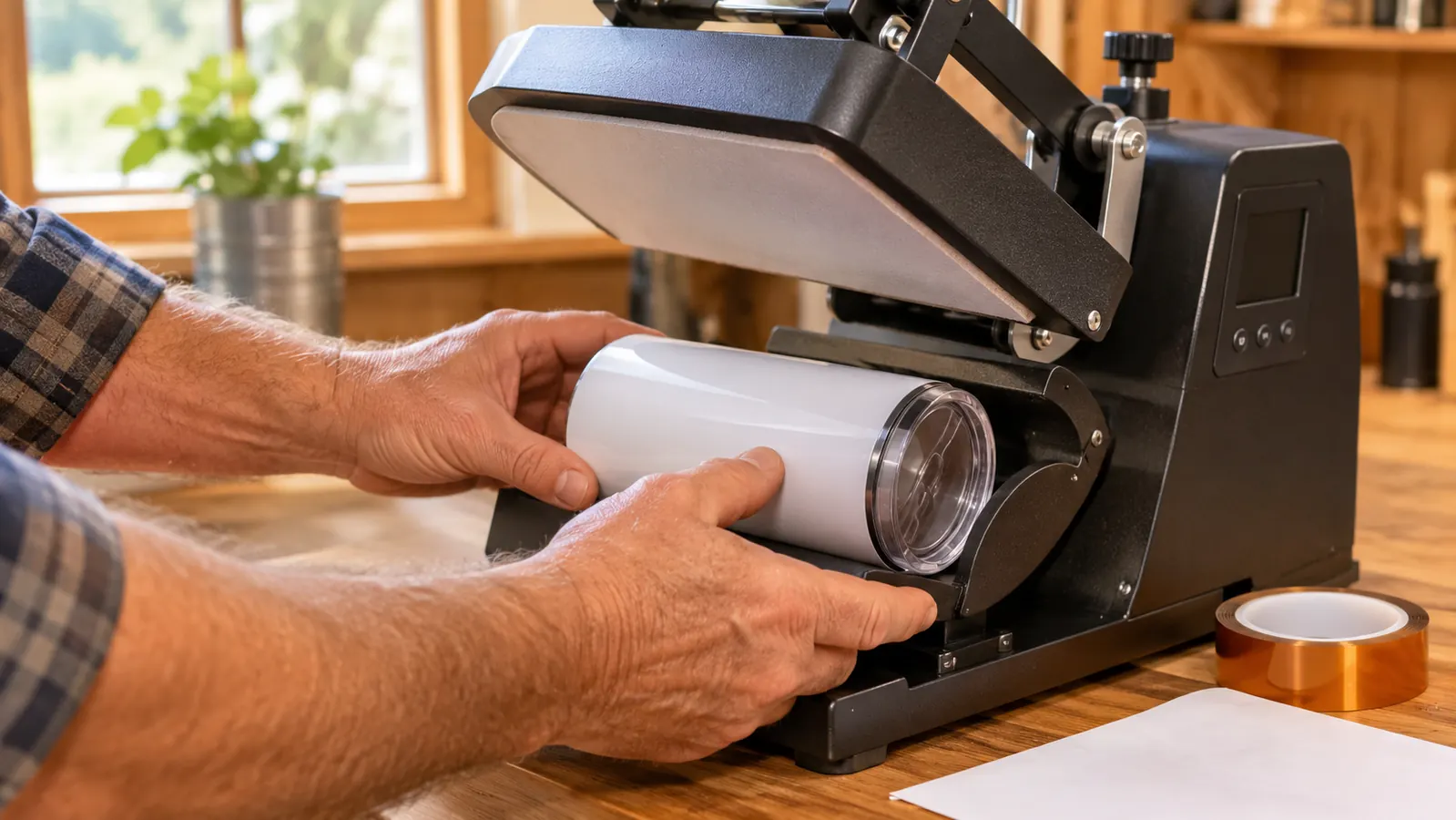
The press wins on repeatability, and repeatability is the entire job once somebody is paying you. You set the temperature, you load the blank, you click it closed, and the machine does the pressing. There is no tape to lift and no sleeve to fold. The heat pad comes down on the blank with the same pressure on tumbler one and tumbler twenty-four, which is the one thing the oven method cannot promise no matter how good your hands get.
The other feature I did not expect to care about as much as I do is the R button. Press it and the machine halts heating and releases the heat pad instantly. That sounds like a small convenience until you have spent an afternoon peeling hot shrink sleeve off a mug with tongs while the clock runs. Being able to stop and get the blank out without wrestling the machine is the difference between a job that feels controlled and a job that feels like a small emergency every twelve minutes.
The run that sold me was twenty-four tumblers for a youth softball team last spring, all the same design, with a number on the back of each one. I set the machine to 360 °F, loaded the first blank at nine in the morning, and worked through the whole stack in one sitting with a cooling rack set up beside the bench. Each tumbler took a few minutes under the pad and a couple more to cool enough to handle. I was finished before lunch, and when I lined all twenty-four up along the workbench every logo sat at the same height on the barrel. With the oven I would have been wrapping until noon and still checking seams.
It also holds a set temperature anywhere between 210 and 390 °F, which covers the full range I actually use, low for polyester blends and higher for the sublimation coatings on hard blanks. An oven swings, and every time you open the door to load or unload you drop the temperature again, so the honest way to run an oven is to give it twenty minutes to recover between loads. The press does not have that problem, because you are not heating a cavity. You are heating the blank.
Twenty-four team tumblers in one afternoon and not one crooked logo. That is the whole argument for the press.
Where the Oven Wrap Method Wins
Here is where I will defend the oven, because it does two things the press cannot. The first is variety. The HTVRONT takes tumblers from 2.9 to 3.2 inches in diameter and 10 to 30 oz, and that covers nearly every standard skinny tumbler and mug in the craft market. It does not cover a wide stein, an odd handled mug, or a tapered water bottle. The oven does, as long as the thing fits on a rack. If your whole product line is built on unusual drinkware, that single point matters more than everything else in this article.
I ran into that limit in a way I remember clearly. A customer brought me four wide handled steins from a trip she had taken, each one about four inches across the body, and wanted the same mountain design on all four of them. They would not sit in the press without the pad riding up one side of the barrel. I wrapped them, sleeved them all, and baked them in two batches, and they came out lovely. It also took me an entire evening for four pieces, and I checked the oven thermometer twice because the door had been open long enough for the reading to drift on me.
The second is batch size. The press handles one tumbler at a time and that is the honest limitation of it. An oven rack holds a full load, and if you already have your wrapping down, you can cycle several blanks at once and come back to a tray of finished pieces. For a big run of identical mugs where the wrap and the timing are already dialed in, an oven can genuinely finish a batch faster than a single press can. I would not recommend it to a beginner with no temperature discipline, but I would not pretend the throughput point is nothing either.
If wrap tension is the variable you cannot control, take it out of the equation.
The HTVRONT Auto Tumbler Heat Press clamps the same way on every blank. Set the temperature, click it closed, press R when you want the pad off. It fits 10 to 30 oz tumblers and comes with a one year warranty.
Amazon Check Today's Price on Amazon →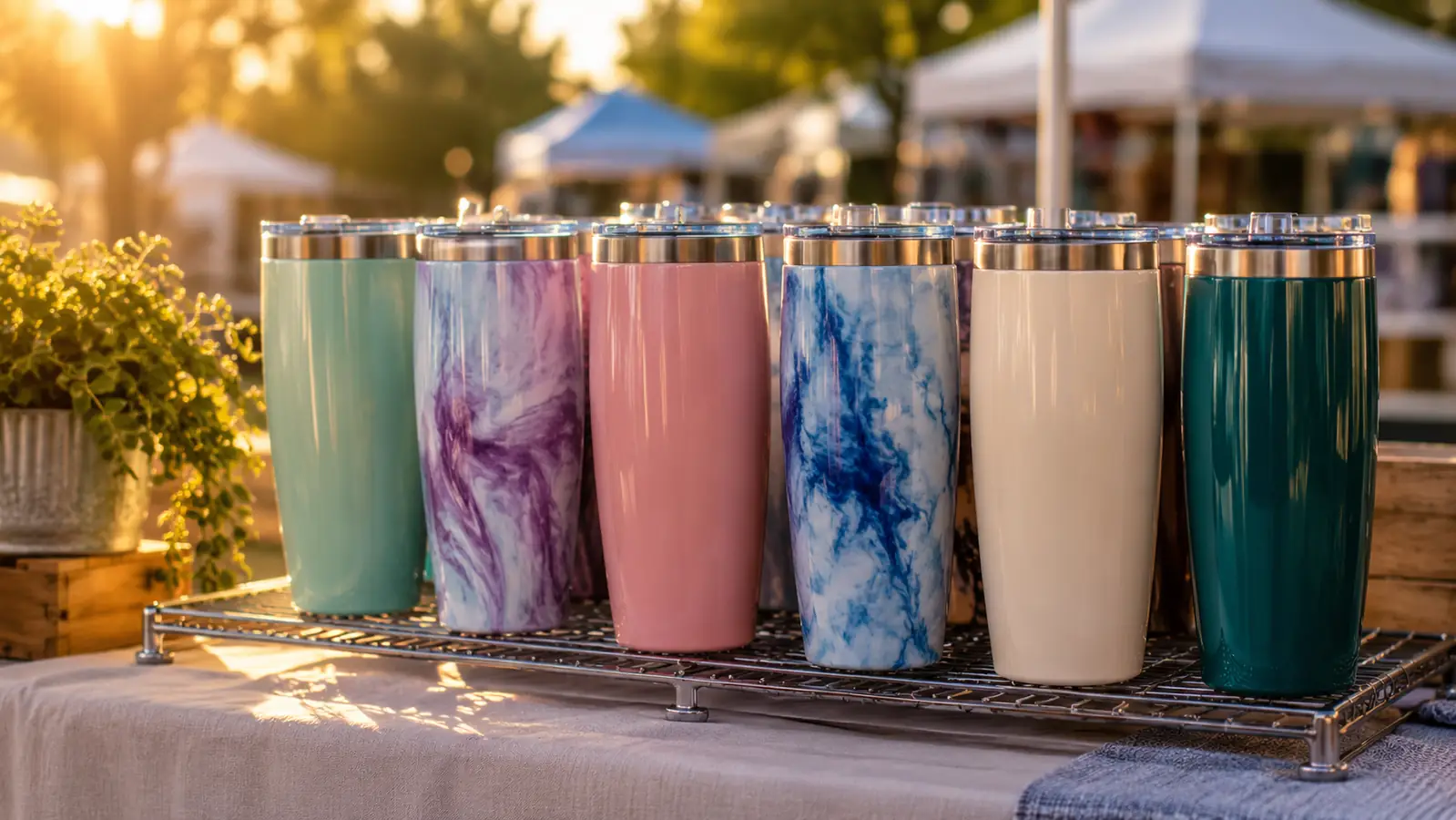
What the Spec Sheet Actually Tells You
The machine measures 12.9 by 10.9 by 6.3 inches and weighs 4.92 kg, so it lives on a workbench and it stays there. I would not carry it to a fair and back every weekend unless I had no other option. Mine sits on the bench in the press room and I bring finished blanks to the fairs instead, which is a lot easier on my back.
It draws 600 watts at 120 volts, so an ordinary household outlet handles it fine, but it also means it does not belong on a power strip already loaded with a mug press and a heat gun. Give it its own outlet and you will not spend an afternoon wondering why the temperature keeps wandering on you.
The 210 to 390 °F range is the number I would check first against your blanks, because sublimation coatings vary and a tumbler that wants 360 °F will look washed out if you press it at 320. The one year warranty is worth writing on the calendar, too. That window is roughly as long as your learning curve, and you want to know when it closes before you actually need it.
What I Liked
- Presses with the same pressure on the first blank and the last one in a batch
- Holds any set temperature from 210 to 390 °F
- R button stops the heating and releases the heat pad instantly
- Fits standard tumblers from 10 to 30 oz and 2.9 to 3.2 inches across
- 600 watts on a normal outlet, with a one year warranty
Where It Falls Short
- One tumbler at a time, with no batch loading
- Wide steins, handled mugs and tapered bottles fall outside the size range
- At 4.92 kg it is a bench machine, not a tote bag machine
- You still need the oven's patience for anything oddly shaped
The Setup I Actually Run Now
I did not throw the oven out. It is still in the kitchen, and it still earns its place about once a month when someone brings me a wide camping mug or an odd shaped stein that will not fit in the press. What changed is which tool does the everyday work. Tumblers, skinny mugs, team orders, anything in a run of more than three: those go on the press, one after another, with the same temperature and the same clamp, and I stop thinking about them.
The thermometer was the fix for a problem I caused myself. My oven runs about twenty-five degrees cool against the dial, which I did not know for the first six months, so every blank I baked in that stretch was undercured in a way that only showed up after a few trips through the dishwasher. Now I keep an inexpensive oven thermometer hanging on the middle rack and I write the real temperature on a sticky note on the door. Between that and the twenty minute recovery window, the oven has stopped being the unpredictable part of my month.
The odd shaped pieces get wrapped and baked, because they have to. I check the oven with a separate thermometer now instead of trusting the dial, and I give it a full twenty minutes between loads. That is not a compromise I would want to run a whole business on, but it is a perfectly good way to handle the four pieces a month that nothing else will take.
Who Should Buy Which
Buy the HTVRONT if you are pressing for other people. Team orders, booster club fundraisers, a craft fair table with forty tumblers on it, a small shop that takes custom requests. The moment a customer expects the second print to match the first one, you want the tool that clamps instead of the method that depends on your hands being steady at seven in the morning. That is the whole decision, and everything else in this comparison is detail.
Stay with the oven if you are testing the water. If you have a home oven, a printer, some paper and a pack of shrink sleeves, you can find out this weekend whether you even enjoy sublimation, and you will learn wrap tension and temperature discipline in a way that makes you a better press operator later. The one thing I would add is a cheap oven thermometer, because the dial on a domestic oven is a suggestion, not a reading.
Stop re-taping. Start repeating.
Same pressure, same temperature, same result on tumbler twenty-four as on tumbler one. The HTVRONT Auto Tumbler Heat Press does one job and does it the same way every single time.
Amazon See Today's Price on Amazon →