
The first shirt I ruined on a heat press had a scorch mark in the shape of a platen corner, right across the shoulder blade. I had set the temperature too high, answered the phone, and come back to a smell I can still recall. The shirt went in the bin and the customer got a replacement out of my own stack. The lesson stuck with me, and it was not really about temperature. A press that needs a person standing over it is a press that will eventually get ruined by that person getting distracted.
That is the whole reason I wanted to try the HTVRONT Auto Heat Press. It is a 15 by 15 inch machine with auto release, which means the platen lowers onto the shirt and lifts back off on its own instead of me leaning on a handle for the full count. It has lived in the press room for several weeks now, through a booster club order, a set of youth soccer jerseys, and a run of shirts for my own small shop. Some of it went well and some of it needed adjusting. Here is the honest version.
The Quick Verdict
Takes the lean-and-hold out of shirt work, reaches 320°F in under four minutes, and wants a solid bench. Best for anyone pressing in batches.
Amazon Check Today's Price →Press one shirt while the next one is still on the rack
The HTVRONT Auto Heat Press runs the down-and-up cycle on its own, so your hands are free the moment the platen lands. 4.6 stars across more than 6,700 reviews.
Amazon Check Today's Price on Amazon →How I've Used It
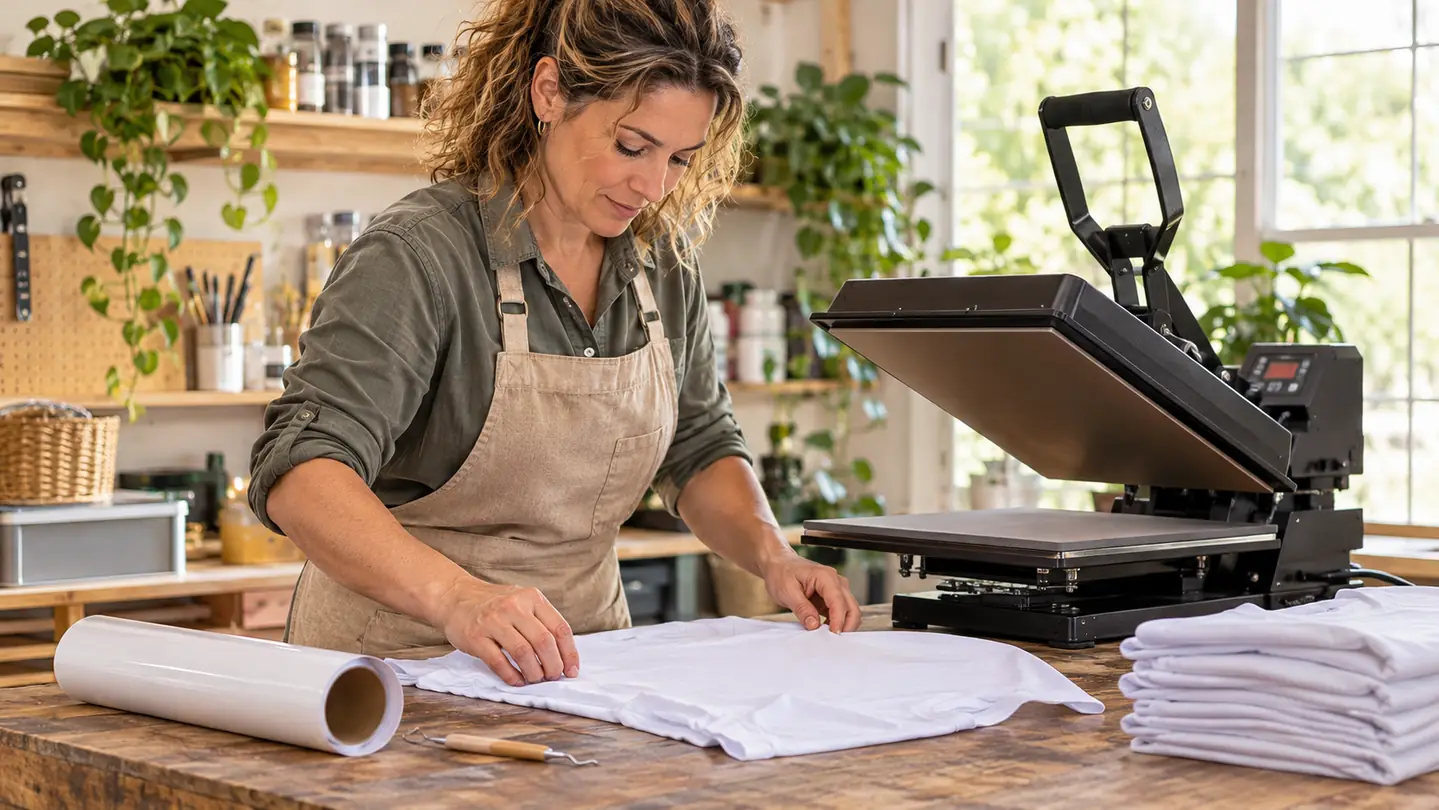
The press room is a converted spare bedroom, and the machine sits on a heavy workbench against the far wall. The unit measures 20 inches long, 12 inches wide and 16 inches high, and it weighs 40.3 pounds, so I treated it as a fixture from the start rather than something I would move around. It runs on 120 volts, which the spare bedroom circuit handles fine, and I have not tripped a breaker once, including on evenings when I was also running a small heater in the hallway. If your craft space shares a circuit with a space heater or a window unit, that is worth checking before you plug in.
My first week with it was really about unlearning a habit. On my old manual press, the countdown in my head was a countdown on my arms. With this one I set the temperature and the time, press the button, and step back. For the first several shirts I caught myself hovering with one hand out, waiting to lift a handle that was not there. That is a small thing to describe, but it tells you what the machine changes. It changes who does the waiting.
The booster club order was 46 shirts, all cotton, all the same design across three sizes. I did it over two evenings after work, and the part that surprised me was how much of that time was not pressing. Weeding the vinyl, lining up the design, checking the placement against a template, that is where the hours went. The press itself became the easy part of the job. The second evening I finished a full 24 shirts and did not feel like I had been in a fight afterward, which is more than I could say for the manual press.
What a 15 by 15 Inch Platen Actually Covers
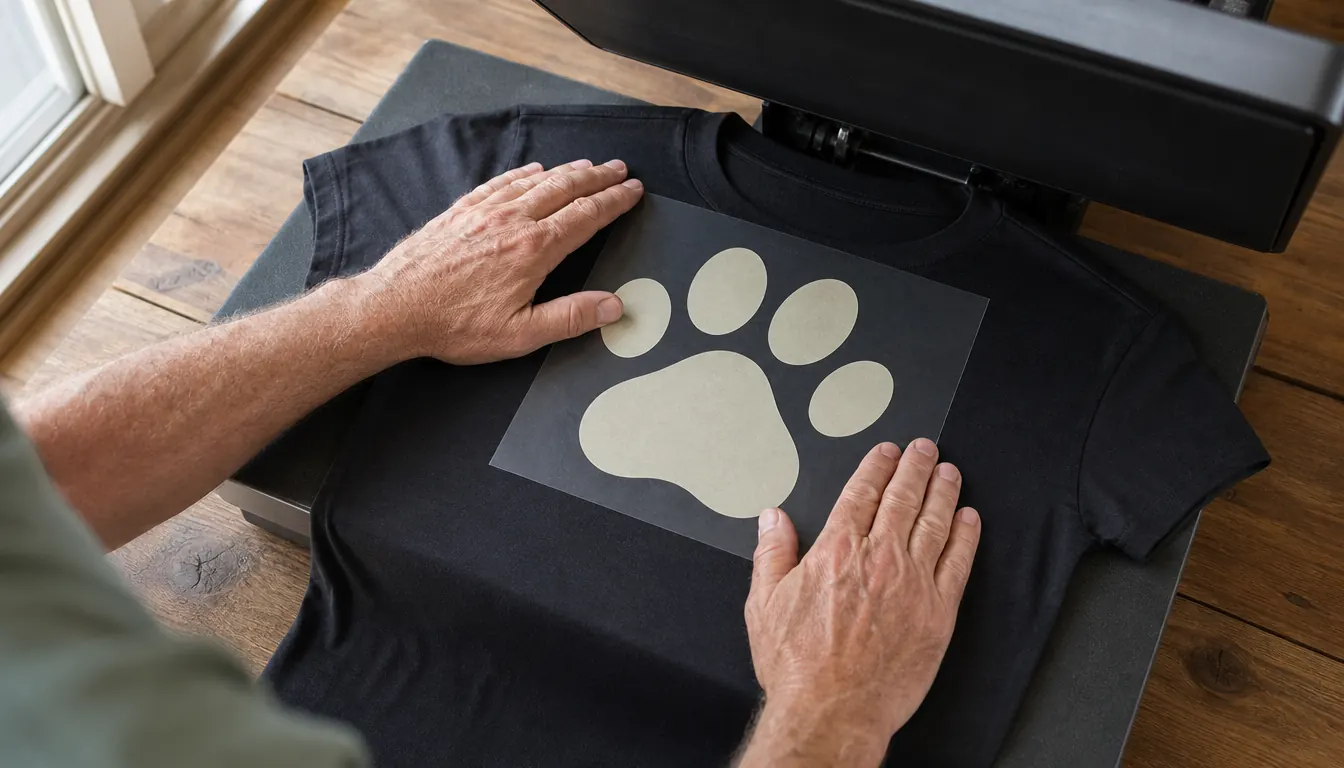
Fifteen inches square is enough for a full adult front or back print. I lay a large shirt across the lower platen and the design sits well inside the edges with room to spare for alignment. Youth sizes look almost lost on a surface that size, which is not a complaint. Where the size matters is the middle ground, the adult 2XL back print, and that fits with room to shift the design if you want it higher on the shoulder.
The 20 by 12 inch footprint is the number you actually need to plan around. Mine takes up most of a bench that is two feet deep. Because the top lifts straight up rather than swinging to the side, I did not need side clearance the way I did with a clamshell, and I could push it six inches closer to the wall than my old press allowed. In a converted bedroom, six inches matters. It is the difference between a workable layout and a room you cannot walk through.
One note on the table underneath. At 40.3 pounds the machine does not slide around much, but it will walk slightly if the bench is not solid. I put a rubber mat under mine and it stopped. If you are setting up on a folding table, do not. Not because the machine will fall, but because every press you make will be slightly uneven, and uneven pressure is how you get a design that peels at one corner three washes later.
Heat, Time, and That Four Minute Warm-Up
HTVRONT lists a warm-up to 320°F, which is 160°C, in about four minutes. That matches what I saw with a stopwatch at the bench. My old press took closer to eight minutes to reach the same point, and I used to plan my mornings around switching it on before I did anything else. Four minutes is short enough that I can preheat, lay out the first shirt, and be pressing before the coffee finishes brewing. Small thing. It changes how often I bother to press one shirt instead of waiting for a pile.
The working range runs from 160°C to 210°C, which is 320°F to 410°F. Most of my vinyl work lives in the lower half of that. I press cotton at the low end and move up for heavier blends where the vinyl needs a little more encouragement to bite. The evenness is the part I did not expect. On a manual press, the corners of a large design can come up light if your pressure is uneven across the platen. I have not had a peeled corner since I moved to this machine, and I have pressed through a full bag of the vinyl I use most.
If you are coming from a household iron or one of the small handheld presses, the difference is not speed. It is repeatability. The same temperature for the same time on every shirt means the tenth shirt looks like the first one, and that is the thing a customer notices when they order four shirts for a family photo. They do not inspect your technique. They put all four on the same bed and look at them side by side.
The Modes, and Which Ones I Actually Touch
The listing says four fast modes, two custom modes and an auto mode. In practice that means four preset buttons for the everyday work, two slots where you save your own temperature and time, and a mode where the press runs the cycle by itself without you touching it after the start. I did not think I would use the custom slots. I use them constantly.
I keep one custom slot set for the vinyl I buy most often, so I am not dialing the same two numbers in four times a week. The other slot I change around depending on the job. The fast modes cover the rest, and the auto mode is the one that changed how I work. I load the shirt, send the platen down, and while it is pressing I am weeding the next design or trimming a transfer at the other end of the bench. When the platen lifts, I am already walking back with the next one.
Written out like that it sounds like a small convenience. In the press room it is the difference between a batch of 46 shirts taking two full evenings and taking one long one with time to spare. The machine is doing the part that used to require my hands to be in one specific place, and my hands are now doing the part that actually needs a person. That is the whole case for this press, and everything else in this review is secondary to it.
A batch of 46 shirts used to take two full evenings. With the platen lifting itself, I did it in one long one, and every shirt came out identical.
Where It Stumbles
The warranty is 30 days, and I am not going to dress that up. On a machine this heavy, I would like to see a year. What it means practically is that the first month matters. Run it hard in that window. Press a dozen shirts in the first week, cycle through the modes, check that the platen lifts evenly and that the temperature holds. If something is wrong with the lift mechanism, you want to find out while you are still covered, not in month two.
The auto lift also takes some adjusting with small, light pieces. A tiny left chest design on a thin shirt can shift when the platen comes down if you have not tacked it in place. I lost two that way in the first week, both on the same cheap blank, and I have not lost one since I started pressing the design flat with my hand for a second before sending the platen down. It is a habit now and it costs nothing.
And it is heavy. 40.3 pounds does not sound like much until you are carrying it up a staircase or lifting it onto a bench by yourself. Mine stays where it is. If you do weekend craft fairs and want to press on site, this is not the machine you load into the car every Saturday. Glen loads the car for me and he raised an eyebrow at the box. A smaller press or a handheld unit makes more sense for the fair table.
What It Replaced in My Press Room
For the last few years I pressed on a manual clamshell. It worked, it was simpler, and I am not going to say it was a bad machine. But every shirt on it required me to lean over and hold a handle down for the full time, and over a long batch that is physical work. By the end of a 30 shirt evening my shoulder was done and my accuracy was slipping. The last five shirts of a batch were always the ones with the placement slightly off.
The HTVRONT does not press better than a good manual press. It presses the same. What changed is that I can press for three hours and still be steady on the last shirt, and the last shirt comes out the same as the first. If you press once a month for a birthday shirt, the manual makes sense. If you press every week for orders, the auto release stops being a nice extra and becomes the reason the work stays consistent.
What I Liked
- Auto release lifts the platen without you holding a handle, so long batches stay consistent
- Reaches 320°F in about four minutes, roughly half the warm-up of my old press
- The 15 by 15 inch surface fits a full adult back print, including 2XL
- Temperature holds steady from 160°C to 210°C with no light corners on large designs
- Four fast modes and two saved custom slots cover most everyday vinyl work
Where It Falls Short
- 30 day warranty is short for a machine this heavy
- 40.3 pounds means it stays on one bench, not in the car for craft fairs
- Small, light pieces can shift when the platen comes down unless you tack them first
- Needs a solid, deep bench; a folding table is not enough
Who This Is For
This is for someone who presses in batches. Booster clubs, team orders, a small shop taking custom requests, anyone who has looked at a stack of twenty shirts and felt their shoulder ache in advance. It is also for anyone working alone in a small room, because the auto release means you are not tethered to a handle, and the platen lifts instead of swinging, so the bench can sit close to a wall. If you are doing your first paid order and want the pressing to be the least of your worries while you focus on getting the design right, this is a sensible place to start.
Who Should Skip It
Skip it if you press a few times a year for family and friends. A manual clamshell does the same job and it takes up less room. Skip it if you want to press at craft fairs, because 40.3 pounds and no carry case make that a chore rather than a setup. Skip it if a 30 day warranty is a deal breaker, and for plenty of people it should be. None of those are reasons the machine is bad. They are reasons it might not be your machine, and it is cheaper to work that out now than after the box arrives.
If your shoulder is the bottleneck, this takes it out of the job
15 by 15 inches, auto release, four fast modes and two custom slots. The HTVRONT Auto Heat Press holds a 4.6 star average across more than 6,700 reviews, and the 30 day window is long enough to run a real batch through it.
Amazon Check Today's Price on Amazon →