
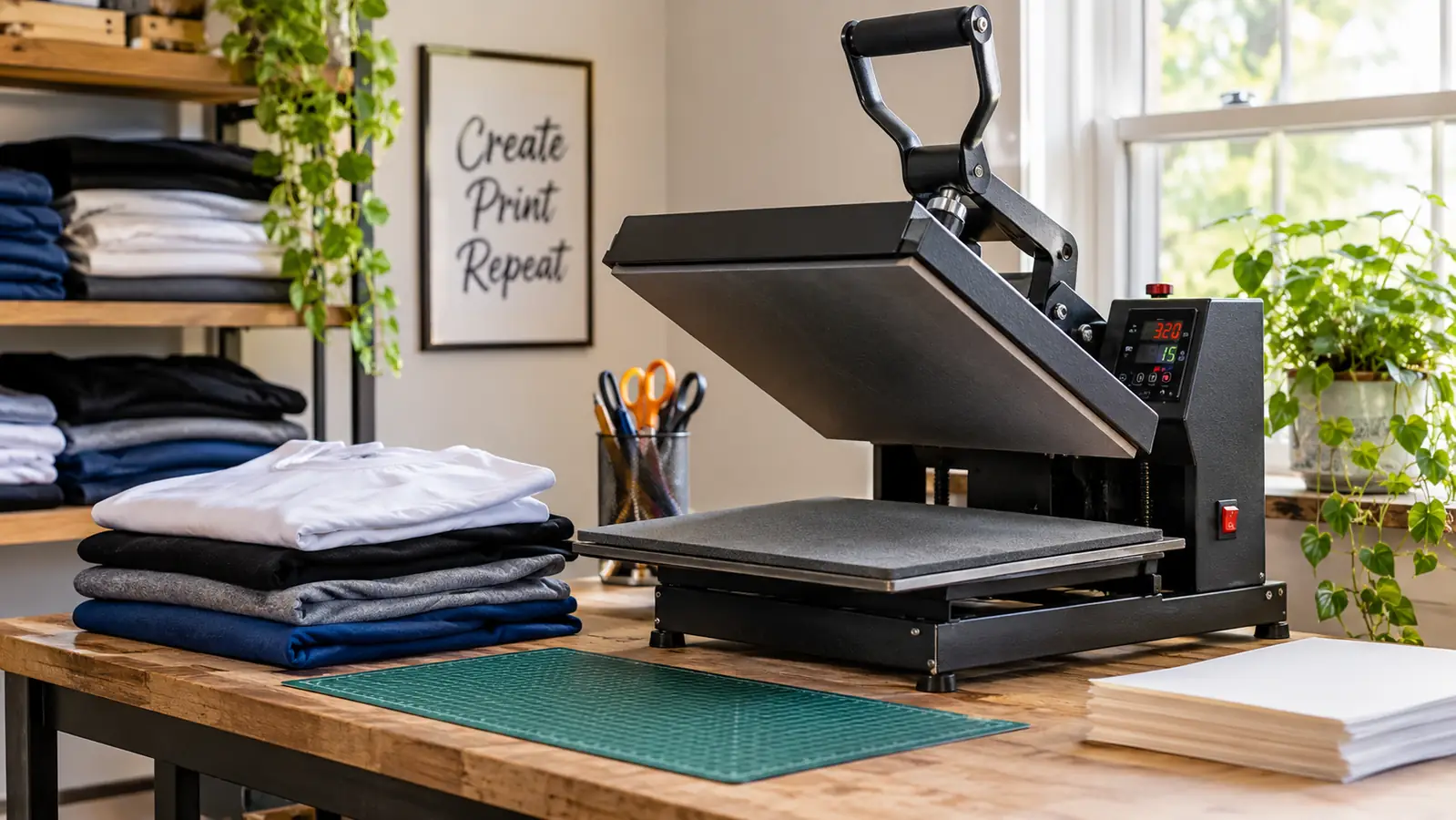
I bought my first heat press four years ago because I wanted matching shirts for a family reunion, and since then I have scorched, bubbled and peeled more vinyl than I would ever admit at a craft fair. The press that finally made the work feel predictable is the HTVRONT Auto Heat Press, a 15x15 machine that lifts its own top platen when the cycle ends. If you are new to this and trying to work out what to buy first, that auto release matters more than any other line on the spec sheet.
Beginners lose money in three places. Pressing too hot. Pressing twice because they were not sure the first press took. And letting a shirt drift sideways while they hold a handle down. All three come from one problem, which is that a manual clamshell asks you to be the timer, the thermostat and the clamp at the same time. Here are ten reasons this machine suits a beginner better than the manual press I started on.
Start with the press that lifts its own handle
A 15x15 platen, auto release, four fast modes and two custom modes. Rated 4.6 stars across 6,717 reviews.
Amazon Check Today's Price on Amazon →The platen lifts itself, so your hands are free at the end of every cycle
On a manual press you hold the handle down for the whole press, which means you cannot trim the next design or answer the door. The auto release on this machine raises the top platen when the cycle finishes. In my first month I stopped pressing shirts twice out of nerves, because I could see the press had done its job instead of guessing. It also means a shirt never sits under heat longer than it should because I got distracted by Glen asking where the bungee cords went.
It reaches 320°F in about four minutes
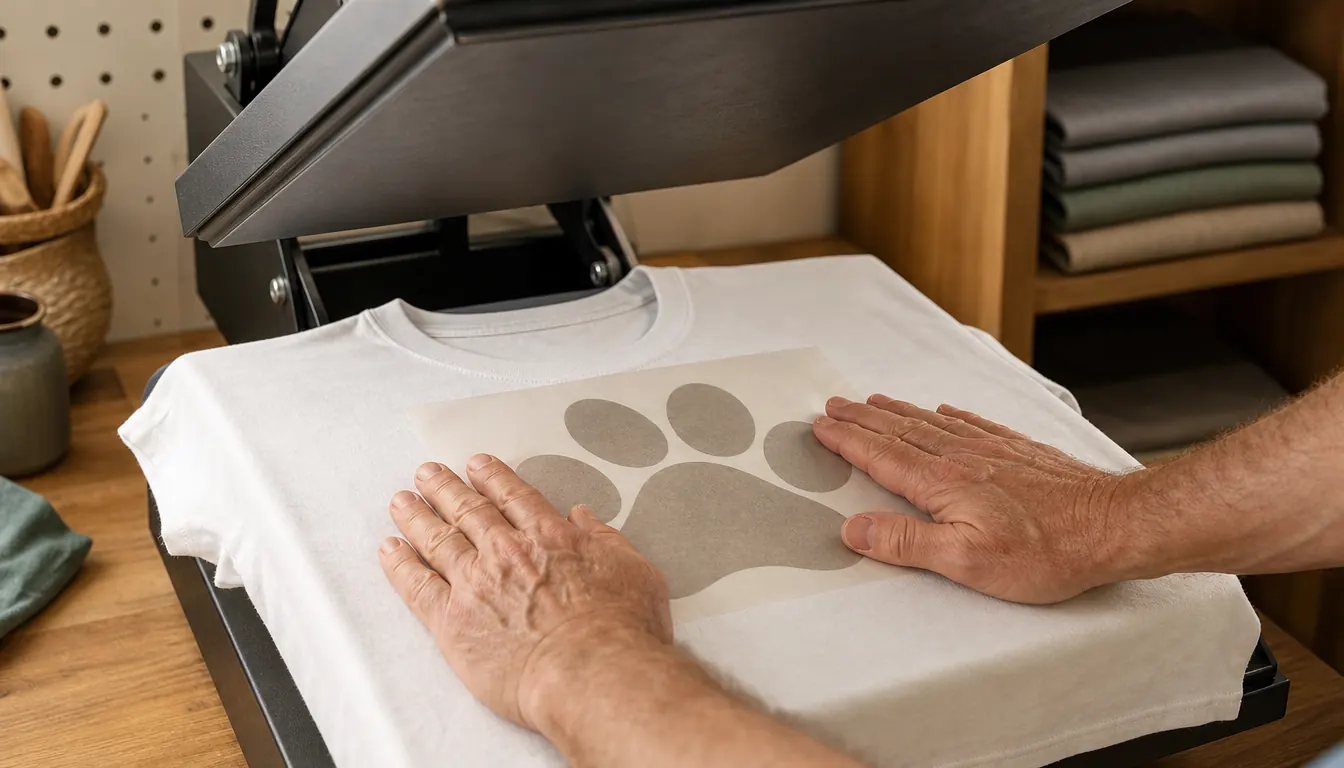
The HTVRONT listing says the press gets to a common-use temp of 320°F / 160°C within four minutes, roughly twice as fast as a standard press. That sounds like a small thing until you are squeezing a single tote order between errands. Short heat-up means you can press one item and turn the machine off, instead of leaving it running all afternoon on the off chance an order comes in.
A 15x15 platen takes a full youth jersey in one pass
My old press was small enough that a size large tee needed two presses and a prayer. The 15x15 surface here covers a full front print, a jersey back number, or a run of small blanks lined up side by side. Fewer passes means fewer seams to line up and fewer chances for a design to shift between presses, which is where most beginner crookedness actually comes from.
Four fast modes cover the jobs a beginner actually does
The machine has four fast modes, two custom modes and an auto mode. The fast modes are the ones I use for everyday blanks: cotton tees, poly totes, a run of team jerseys. You choose the mode, lay your blank, and the press runs a preset cycle. When you are three weeks in and have no reference point for what a good press feels like, presets beat a dial you are guessing at.
Two custom modes remember the settings you dialed in
Every vinyl and every blank has its own sweet spot, and you will find yours somewhere around your third order. The two custom modes let you hold those numbers so you are not re-entering them for every booster club batch. I keep one for the 100% cotton tees and one for the poly blend the youth football team wears, and I have not touched the temperature setting on either since spring.

Auto mode takes the guesswork out of an unfamiliar blank
Auto mode is the one I reach for when someone hands me a fabric I have not pressed before, like a thrifted denim jacket or a canvas apron. Instead of pulling a time and temperature out of the air, I let the machine run its own cycle and check the peel. It is not a replacement for a test press on scrap, and I still do one every time, but it gets you close on the first attempt instead of the third.
At 40.3 pounds it stays put while you load a shirt
A light press slides around when you pull a shirt flat across the lower platen, and that slide is how designs end up rotated two degrees. This one weighs 40.3 pounds and does not walk across the workbench mid-load. It is heavy enough that I asked Glen to lift it onto the bench when it arrived, and it has not moved since. Firm and stationary is exactly what a beginner needs.
It fits a converted spare bedroom at 20 by 12 by 16 inches
The press room is the second bedroom of our house in Vancouver, Washington, and floor space is the thing I run out of first. The machine measures 20 inches long, 12 wide and 16 high, so it sits on a standard folding table with room left for a cutting mat and a stack of blanks beside it. You do not need a garage or a storefront to make this work.
The 160 to 210°C range covers vinyl and sublimation blanks
The lower temperature rating is 160°C and the upper is 210°C, which is the band most heat transfer vinyl, sublimation blanks and transfer sheets ask for. Having a real top end means I am not maxing the machine out on a sublimation panel and waiting for it to catch up mid-order. Having a real low end means the shirts I actually care about do not get cooked while I learn.
6,717 reviews means somebody already made your mistake
The HTVRONT press sits at 4.6 stars across 6,717 ratings, and I read a good number of them before I bought mine. The useful ones were people who wrote down the time and temperature that worked on their blank. A large review base is worth more to a beginner than any feature printed on the box, because it is a written record of what went wrong for other people before it went wrong for you.
What I'd Skip
Two things I would not buy this press expecting. The warranty is 30 days, which is short for a machine this heavy, so register it, run a full test press in week one, and keep the box until you have taken it to one craft fair. And it is a flat press. My mug orders still go through a separate setup in the same room, so if mugs are the whole plan, budget for that separately. It also will not rescue bad vinyl or a dull cutting blade, and I wasted two months blaming the press for problems that were mine. Last thing: 40.3 pounds is fine on a bench and miserable on a closet shelf, so decide where it lives before the box arrives.
The auto release is the one feature I would pay for twice. It turned a press I had to babysit into one I can walk away from mid-cycle.
Stop being the timer, the thermostat and the clamp
Auto release, four fast modes, two custom modes and a 15x15 platen. 4.6 stars from 6,717 buyers.
Amazon Check Today's Price on Amazon →