The first tumbler I ever sublimated came out with a ghost on it. Not a spooky one, just a pale second copy of the design sitting maybe an eighth of an inch off from where it should have been. I had wrapped the paper by hand, taped it, taped it again, and then held a heat gun on it for a very long time while the paper crept under my thumb. The customer was a sophomore at the local high school. She was polite about it. I was not polite to myself about it.
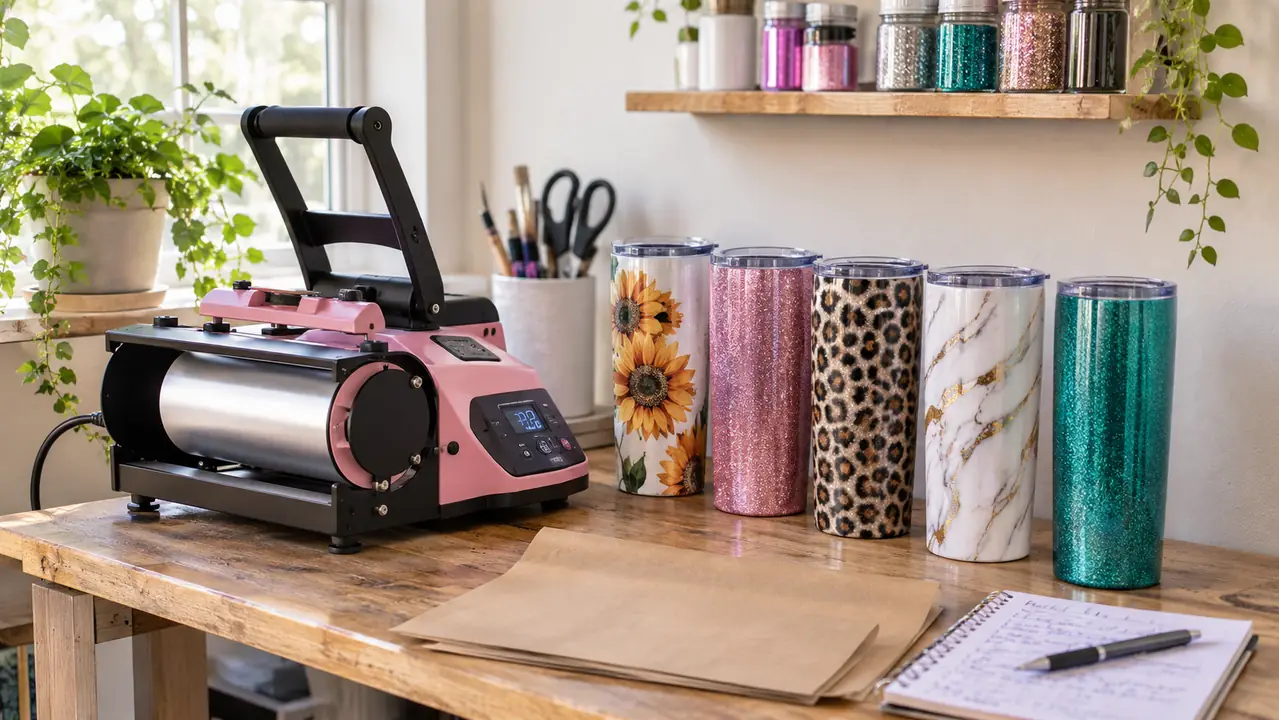
That was two years into this little business of mine. I am four years in now, working out of the converted spare bedroom in my house in Vancouver, Washington, the room I call the press room, and the tool that finally ended the ghosting was the HTVRONT Auto Tumbler Heat Press. Mine has been on the same bench long enough to pick up a scuff on the shell and a permanent ring on the wood underneath it.
The Quick Verdict
A 600-watt automatic press for drinkware from 10 to 30 ounces. It takes the tape, the wrap and most of the standing-and-watching out of tumbler work. It does not cover every size you will be asked for, and you should know that before you buy.
Amazon Check Today's Price →The machine that ended my ghosted tumblers
If you are tired of re-wrapping paper and re-running a cup because the design drifted, this is the tool I reach for first. Check the size range and today's price on the listing before you commit.
Amazon Check Today's Price on Amazon →How I've Used It
Most of what comes off my bench is not glamorous. It is team tumblers for a youth soccer booster club, a batch of twenty for a school staff appreciation week, and the occasional custom order through my small online shop. The press handles the middle of that range better than anything I have used. A 20 ounce tumbler is the workhorse size around here, and once I dialed in my paper and my timing, I could run a set of six in an afternoon without hovering over each one.
I should say plainly what I make. Sublimated 20 ounce tumblers with school logos, water bottles for a cross country team, and a small line of simple floral designs that sell at weekend craft fairs. I do not make the big 40 ounce cups that everyone asks about, because my press will not hold them and I am not going to pretend otherwise to a customer standing at my table.
The thing that actually changed for me was attention. Wrapping by hand means I am holding a hot cylinder, watching a clock, and hoping the paper does not slip. With an automatic press I load the tumbler, click it into place, and step away to trim the next design or answer an email from a booster club mom. That sounds small. Over a hundred tumblers it is the difference between a job I dread and a job I can do on a Saturday morning with coffee going.
I still keep my old wrap and my heat gun in a drawer. I use them maybe once a month, for a shape that will not fit the press. Most weekends the drawer stays shut, and that is the whole review in one sentence.
What the Auto Press Actually Does
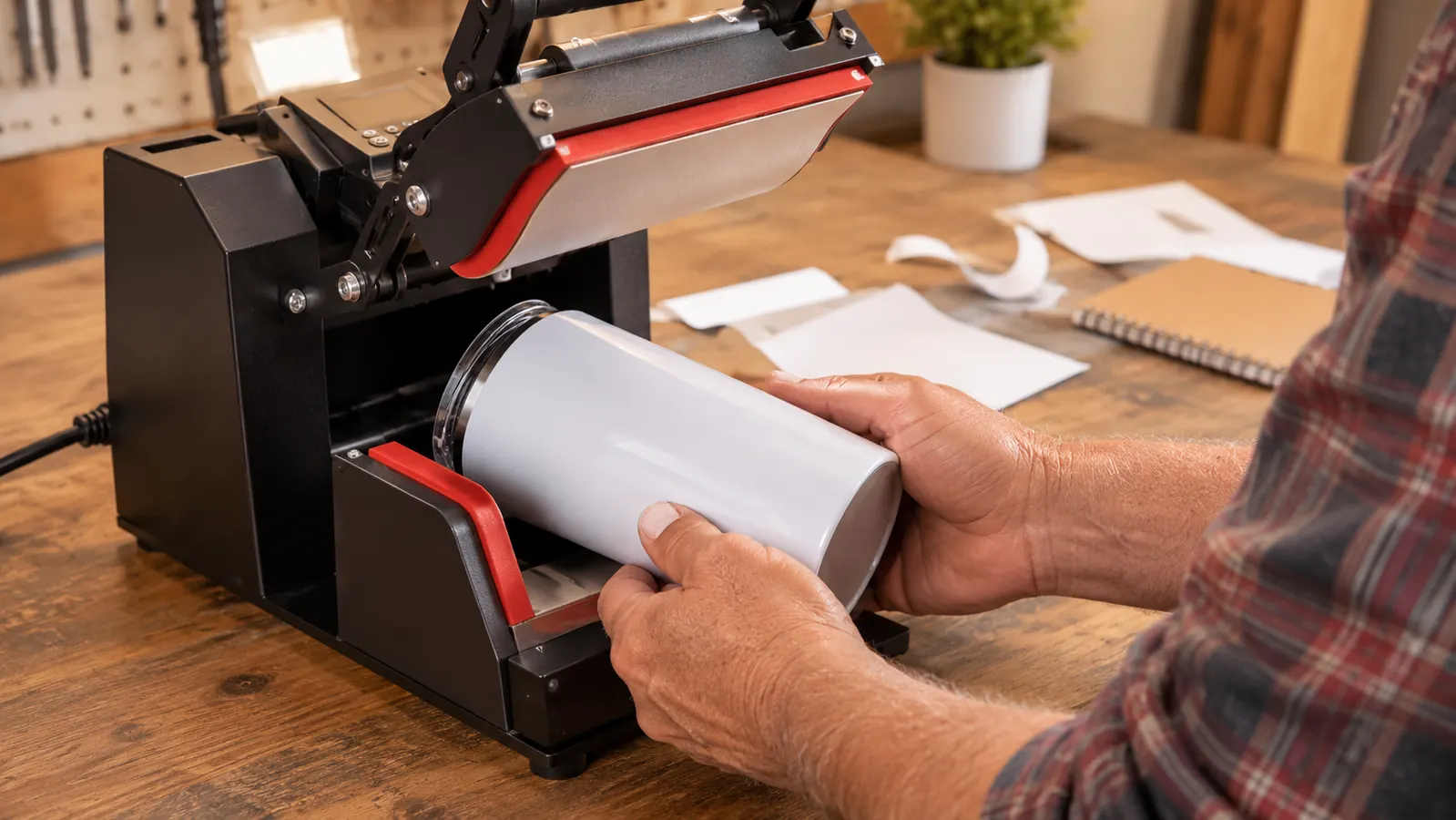
The machine is rated at 600 watts on standard 120 volt household power, which matters more than it sounds when your workshop is a spare bedroom with ordinary outlets and no shop wiring. It weighs 4.92 kg, so it stays where you put it rather than being something you hoist onto the bench and off again. The footprint is 12.9 inches long by 10.9 inches wide, standing 6.3 inches tall, and the shell is ABS. Mine sits against the wall behind my bench and I have never once wished it were smaller.
The working range is 210 to 390 degrees Fahrenheit. The lower end is where I live for thinner drinkware, and the top end I use rarely, mostly when I am running something with a heavier coating and a design that wants a longer dwell. It holds tumblers from 2.9 to 3.2 inches in diameter, with a capacity of 280 ml to 850 ml, which is 10 to 30 ounces in the units I actually think in.
The part that gives the machine its name is the press itself. You load the tumbler, click, and the press closes and applies the heat pad on its own. No leaning on a handle, no counting in your head while your forearm goes numb, no tape letting go halfway through because you flinched. HTVRONT rates it for one year, which is an honest number for a machine in this class and worth writing on your calendar the day it arrives.
The ABS shell deserves a word of its own. It is not metal, it does not look like a shop tool, and mine has shrugged off a year of paper trimmings, two tipped-over ink bottles, and one incident with a spray bottle without showing any of it. If you want your equipment to look like it belongs in a garage, this will disappoint you. If you want it to look like it belongs in a spare bedroom, it fits right in.
The R Button Is the Part I Underrate
There is a button marked R, and pressing it stops the heating and releases the heat pad instantly. My first reaction was that this was a small convenience. It is not. When you are running a batch, the gap between one tumbler coming out and the next one going in is where mistakes happen, and having the pad let go the moment you want it to instead of waiting out a cycle means you set the hot cup on the rack and pick up the next one while your hands still know what they are doing.
It also saved me on a bad load. I had a tumbler sitting slightly off center, noticed it about four seconds in, and hit R. The pad released, I reset the cup, and I pressed it again. Without that button I would have either let a crooked print run to the end or tried to pull a hot tumbler out from under pressure, which is how people burn forearms and crack cups. That one save paid for the feature in my mind.
Where the 10 to 30 Ounce Range Lands
I want to be plain about sizes, because this is where most disappointment starts. If you came to this page because someone asked for a 20 ounce skinny tumbler, a 12 ounce can cooler, or a standard 30 ounce handled tumbler, you are in range and you will likely be happy. If your money comes from 40 ounce quenchers or wide-base travel mugs, this is not the machine for you, and no amount of clever paper wrapping changes the diameter it can hold.
The diameter window of 2.9 to 3.2 inches is the real constraint, more than the ounce count. HTVRONT lists that number on the listing and it is worth reading twice. I keep a cheap caliper on the bench, a habit I picked up after one too many surprises, and I measure anything unfamiliar before I commit paper to it. If a customer brings me a bottle they love, I measure it before I quote them. That single habit has saved me more grief than anything else I have learned in four years.
Heat, Timing and the Learning Curve
The first thing I tell anyone who asks me about buying a press is that the press is a third of the job. Paper, ink, and the blank itself do the rest. A discount tumbler with a thin coating will ghost on you no matter what, and I learned that the hard way with a batch of cups that looked lovely in the photos and came out blotchy and uneven.
For a 20 ounce tumbler with my usual sublimation paper, I run around 365 degrees Fahrenheit and I let the press do the counting. I keep a notebook, not a spreadsheet, and I write down the blank, the temperature, and whether I liked the result. After a few months that notebook is my real instruction manual, and it beats any chart online because it is full of my blanks, my paper, and my winter humidity.
The learning curve is about six to eight tumblers. Not six to eight hundred. Run six with different blanks and different times, write each one down, and by the end you will know what your setup wants. The press makes that experimenting cheap because the heat comes on evenly, so a bad result tells you something true about the blank or the paper instead of just telling you that your hand slipped.
Six to eight tumblers is the whole learning curve, not six to eight hundred. An even press makes each experiment tell you something real.
What It Has Not Solved For Me
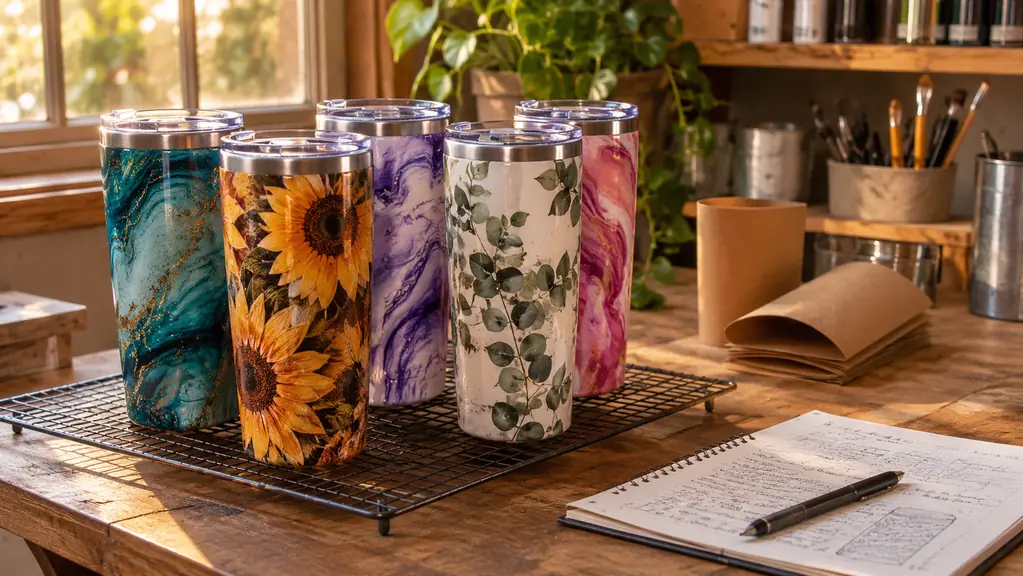
The press does the pressing. It does not do the design and it does not do the finishing. I still hand trim every wrap, still tape the seam, still check the edges of the print before a cup goes in. A press that closes itself will happily press a bad wrap perfectly and evenly, which means you get a beautiful, crisp, permanently ruined tumbler with no one to blame.
I also still wash and dry every blank before it touches paper. Oils from handling are real, and they show up as patchy areas that look like the press failed when actually the cup was dirty. And I still let tumblers cool completely on the rack before I touch them, because peeling a hot wrap is how you lift a corner of the coating and wreck a print you already spent time on. None of that changed when I bought a machine. The rest of the work just got easier to do well.
The Noise, the Bench and the Small Annoyances
The machine is not loud, but it is not silent either. In a spare bedroom the sound of it closing is noticeable enough that Glen has learned to knock before he comes in. It puts out real heat, and in July my press room gets warm enough that I open the window and set a fan on the floor pointing away from the bench. That is a room problem more than a machine problem, but it is worth knowing if your work space is small and the door stays shut.
Warm-up takes a few minutes, so I switch it on before I start trimming paper and let it settle while I work. I would not call that a complaint. Every press I have used wants the same courtesy. But it does mean the machine is not something you fire up for one tumbler and shut off again. It rewards being used in batches, which suits the way orders actually arrive.
What I Liked
- The press closes and applies the heat pad on its own, so your hands are free between tumblers
- The R button stops heating and releases the pad instantly, which rescues a crooked load
- Covers 10 to 30 ounces and 2.9 to 3.2 inches in diameter, which is the bulk of everyday drinkware orders
- 600 watts on ordinary 120 volt household power, no shop wiring needed
- Compact 12.9 by 10.9 inch footprint that lives on a spare bedroom bench
- One year warranty, worth diarising the day it arrives
Where It Falls Short
- Will not hold 40 ounce quenchers or wide-base travel mugs
- The diameter window means measuring every unfamiliar blank before you quote
- One year of coverage is on the short side for a machine you run hard
- Does nothing for flat goods like shirts and tote bags
- You still have to get blanks, paper and timing right yourself
Who This Is For
This is for the person who has already made a few tumblers by hand and is tired of it. You know what a wrap looks like when it slips. You have a booster club or a team or a small shop that keeps asking for drinkware. You work in a spare room or a garage on ordinary outlets and you do not want to rewire anything. You would rather spend your evenings designing than babysitting a heat gun.
It is also a decent first press for someone moving up from hand wrapping, because the automatic action covers for the fact that your hands are still learning. The press closing on its own means even pressure, and even pressure is the single hardest thing to do by hand. I could not do it consistently four years ago and I cannot do it consistently now, which is why the machine does it.
And there is one more group I want to name: the person who has been avoiding drinkware entirely because wrapping scared them off. If you have been telling customers you only do shirts, this press is the least painful way I know to open that door without giving up your whole weekend to a new craft. Make twenty tumblers for your own family first. If you still enjoy it after twenty, you have something worth selling.
Who Should Skip It
Skip it if your orders are 40 ounce quenchers, wide-base travel mugs, or anything outside that 2.9 to 3.2 inch diameter window. Skip it if your main product is flat goods, because t-shirts and tote bags need a different machine entirely and this one will not help you. And skip it if you want a press to fix a problem that is not the press.
That last point deserves its own breath. If your prints come out faint, look at your paper and your ink first. If your colors are muddy, look at the coating on your blank. A press gives you even heat and even pressure and nothing else. It does not give you good blanks or a good printer, and no machine on the market makes up for either of those.
Finally, skip it if you are not going to measure. The most common complaint I see about presses like this, in reviews and in the groups I lurk in, comes from people who bought first and discovered their favorite blank was a hair too wide. That is not the machine failing. That is a number nobody checked, and it costs you a return and a week of waiting.
Measure your blank, then decide
If your drinkware sits between 10 and 30 ounces and 2.9 to 3.2 inches across, this press will do the repetitive part for you and leave your hands free. Check the size details and today's price on the listing.
Amazon Check Today's Price on Amazon →