Four years ago I made matching shirts for a family reunion with a heat press, a stack of transfer sheets, and a lot of hope. The first three came out clean. The fourth had a ghost of the design sitting about a quarter inch to the left of where it should have been, and I spent forty minutes picking at it with my fingernail while Glen asked whether we were still leaving at noon. That was the week I started reading about machines built for one job instead of two. I run a Brother sublimation printer in the spare bedroom I call the press room now, and the change was never about speed.
Here are the ten reasons it earned the shelf space, roughly in the order they mattered to me. Some are about the quality of the print. Some are about the hours I got back on a Saturday. If you are pressing with a converted setup or ordering transfers from a supplier, you will recognize more than a few of these.
One machine, one job, and the same result on the thirtieth shirt
The Brother Sublimation Printer runs dye-sublimation designs from the Artspira app on your phone or tablet, then hands them to your press. See today's price and what buyers say.
Amazon Check Today's Price on Amazon →It only ever does one job, so nothing gets crossed up
A converted printer asks you to swap ink, swap paper, and hope the profile you saved is the profile it is actually using today. When it is not, you get banding or washed-out color and you cannot tell which of five variables moved. The Brother is a dye-sublimation machine. Cyan, magenta, yellow and black sublimation ink go in, and that is the only thing it ever does. One variable. When a print looks off now, I know it is the design or the paper, not the machine having an identity crisis.
The white in your design is the shirt itself, so it cannot crack
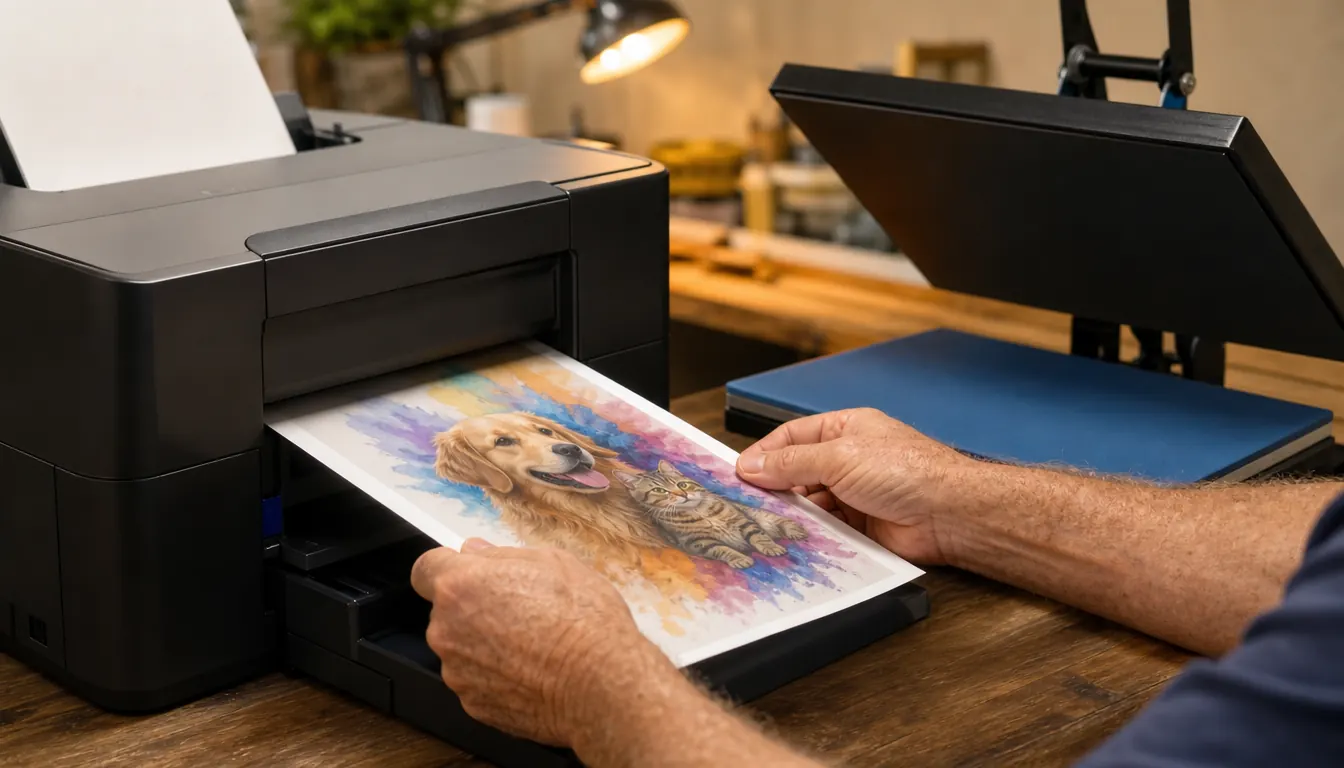
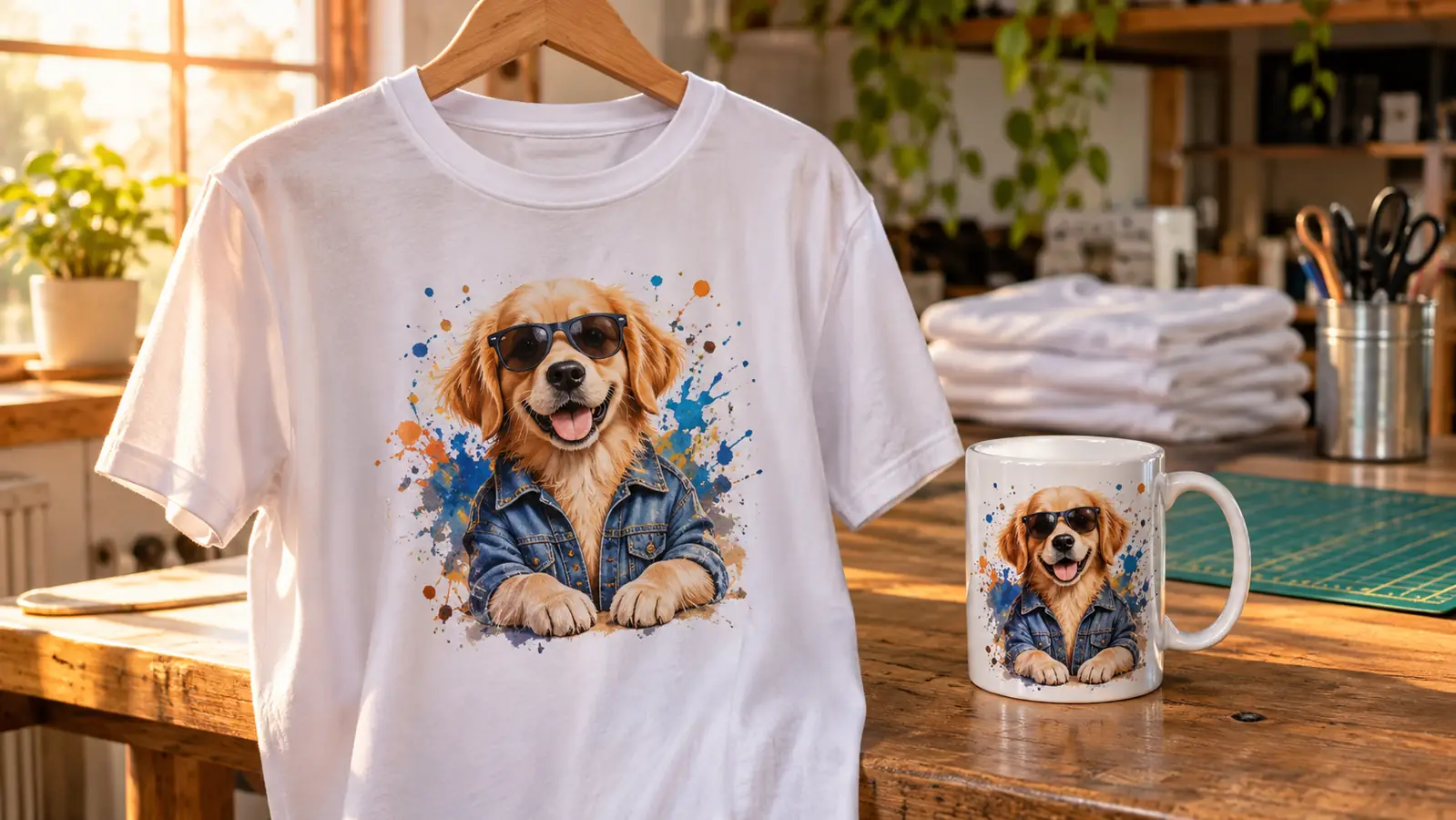
There is no white ink in this machine, and for a long time I thought that was a limitation. It is not. On a white or light polyester blank, the white you see is the fabric, with the dye sitting inside it. Nothing is layered on top of anything. That is why a sublimation print does not lift at the edges the way a heat transfer vinyl job can. My early vinyl shirts are in a drawer with peeling corners. The sublimated ones have been through a whole school year and a gym class schedule.
The design work happens on your phone or tablet, not at a desk
The Brother is powered by the Artspira app, and that is where the whole job starts. I do not sit down at a desktop to build a booster club logo. I do it on the tablet at the kitchen table while dinner is going, save it, and send it over. You can import and save up to twenty printing images in the app, which is more than enough for a school order with a few design variations. The app is not a full design suite and it does not pretend to be, which I find restful.
Repeat orders start from the same saved file, not a fresh guess
The youth football team came back for a second batch in September, three sizes bigger now that the middle school group had grown. I did not rebuild a thing. The saved image was in the app exactly as I left it, and the print matched the first run. If you have ever tried to recreate a design from memory at ten at night, you know what that is worth. Consistency is the thing that gets you asked back, and consistency is easier to promise when the file never moves.
It prints on fabric and thermal paper, which covers the work
The print media on the spec sheet reads fabric and thermal paper. In practice the paper is what I feed it, and the fabric is where the design ends up after the press. Shirts, tote bags, aprons, and the poly-coated blanks that go under the platen. It is a narrow lane, and a small shop lives inside that lane for years before it needs anything wider. I stopped pining for a machine that does everything the day I admitted I only ever make three kinds of thing.
The touch controls and LCD display keep the settings in sight
Control method is touch and the display is an LCD, so settings are a row of visible options rather than a menu you scroll through hoping. On a busy Saturday I am not troubleshooting. I am loading paper and pressing. What I want from a printer in that moment is for the thing it did last time to be visible and one tap away. Small mercy. It adds up across thirty shirts and a deadline, and it is the reason I stopped dreading the fourth hour of a production run.
It weighs 7.9 pounds and fits on a shelf 20.1 inches wide
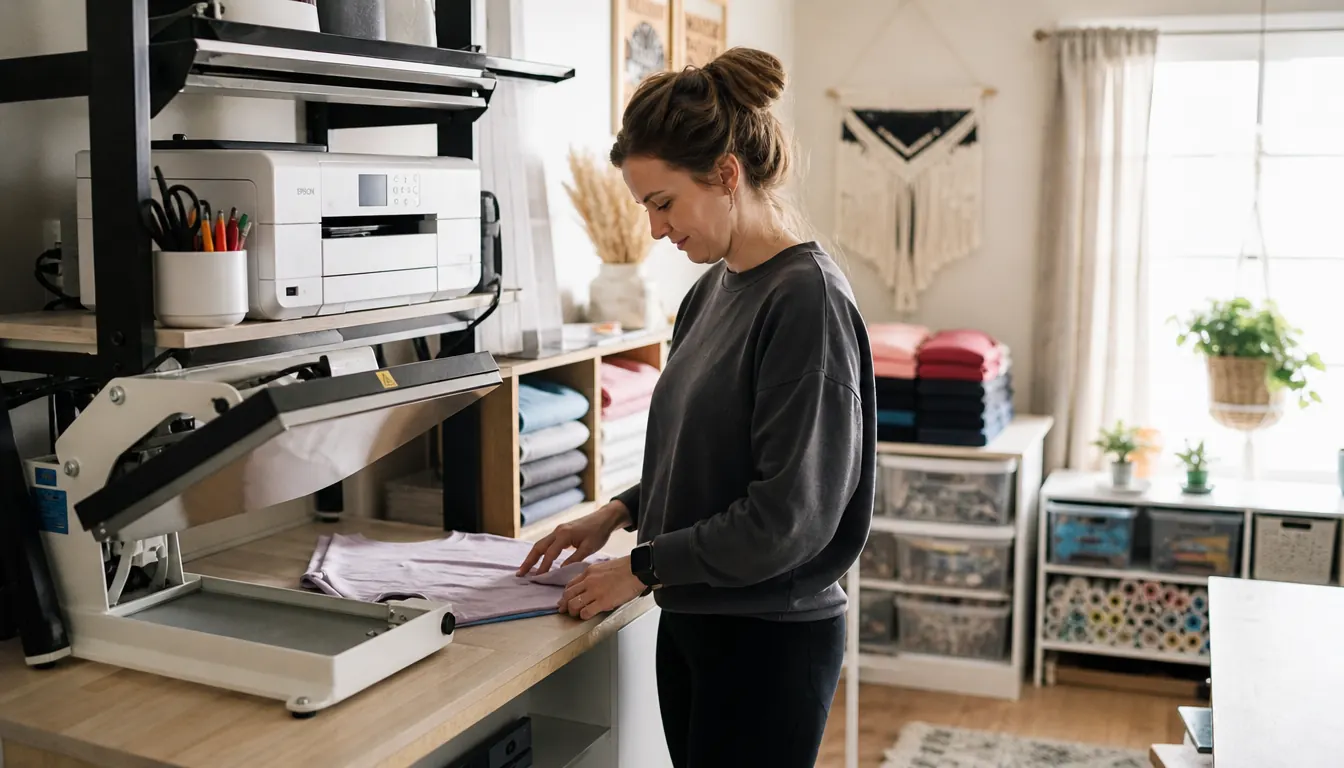
At 7.9 pounds, and 10.8 inches deep by 20.1 inches wide by 19.1 inches tall, this is not a machine that takes over a room. Mine sits on a shelving unit above the press, at chest height, so I can load it without bending. In a converted spare bedroom that matters. Floor space is where the press and the folding table live, and anything that can go up, goes up. Measure your shelf before you buy, then measure it again, because a printer that does not fit is not a bargain.
The scan function earns its keep on school and team orders
Additional printer functions include scan, which sounds like filler right up until a teacher hands you a hand-drawn spirit week design on paper. I scan it, bring it into the app, clean up the edges, and print. Same story with a booster club logo that only exists as a photocopy from 2009. Without a scanner I would be photographing paper with my phone and fighting the glare off a laminated sheet. With it, the artwork goes in flat and straight.
One warranty, one support line, one thing to fix at nine at night
The warranty is limited and I have not had to use it. What I like is the shape of the problem. When something goes wrong the night before a craft fair, I am not deciding whether the fault is the printer, the ink, the profile, or the paper. It is one machine with one job and one support line to call. Two years ago a clogged converted printer cost me an entire evening and a set of mugs. I have not had that evening since, and I have stopped bracing for it.
It let me say yes to orders I used to turn down
This is the reason that actually changed my Saturdays. Before, a request for fifteen shirts with a name on each one meant a week of evenings and a real risk of a bad print on shirt fourteen. Now I look at the order, look at the shelf, and say yes. Not because the machine is fast in some dramatic way, but because it is predictable, and predictable is what lets you commit to a deadline in front of a customer who is standing in front of you.
What I'd Skip
Three things I would skip if I were starting over. I would not buy a case of blanks before I had printed and pressed a dozen shirts, because the fabric blend matters more than any setting and I wasted money on the wrong blend twice. I would not buy a second press to keep up, since the printer was the bottleneck most of the time and a second press just gave me two things to heat up. And I would skip the machine entirely if all I made was a few family reunion shirts a year, because a local print shop will do those for less than the shelf space is worth. My rule is simple. If you are turning down orders, buy it. If you are not, wait.
The white you see in a sublimation print is the fabric, not ink sitting on top of it. That single fact is why my early vinyl shirts live in a drawer and the sublimated ones are still in rotation.
If you are turning orders down, this is the fix
Dye-sublimation only, Artspira designs from your phone or tablet, 7.9 pounds on a shelf above the press. The Brother Sublimation Printer is the machine I stopped worrying about.
Amazon Check Today's Price on Amazon →