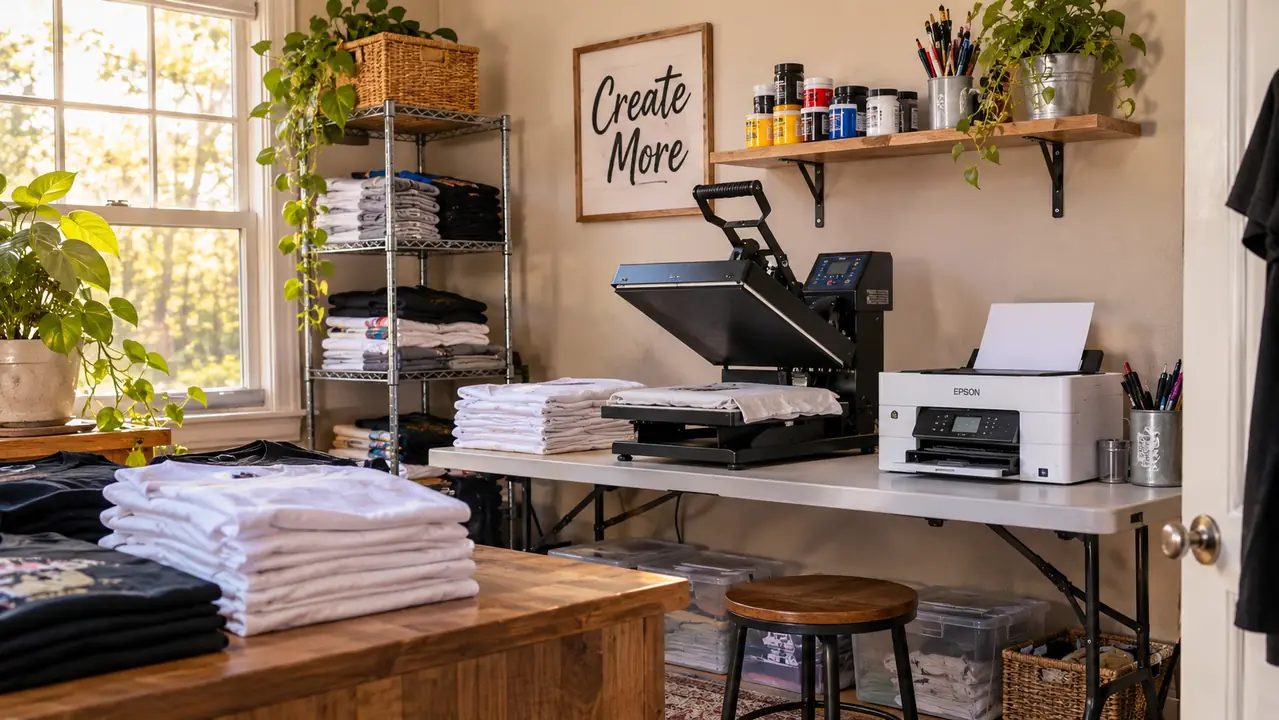
Four years ago my dining table disappeared under a stack of blank shirts, a roll of transfer paper, and a heat press I barely knew how to switch on. I had made matching shirts for a family reunion, and something about watching a design come out of a machine and end up on a shirt I could hand to my cousin, that something stuck. Within a month I had moved into the spare bedroom, hung a folding table on the wall, and started calling it the press room. My husband Glen started calling it the reason we eat dinner in the living room.
What I did not have for the first six months was the right machine. I was printing onto transfer paper with an ordinary office printer and pressing the results onto shirts, and every one of those shirts started cracking along the shoulder seam by the second or third wash. I assumed I was just bad at this. I was not bad at this. I was asking a printer to do a job it was never built for.
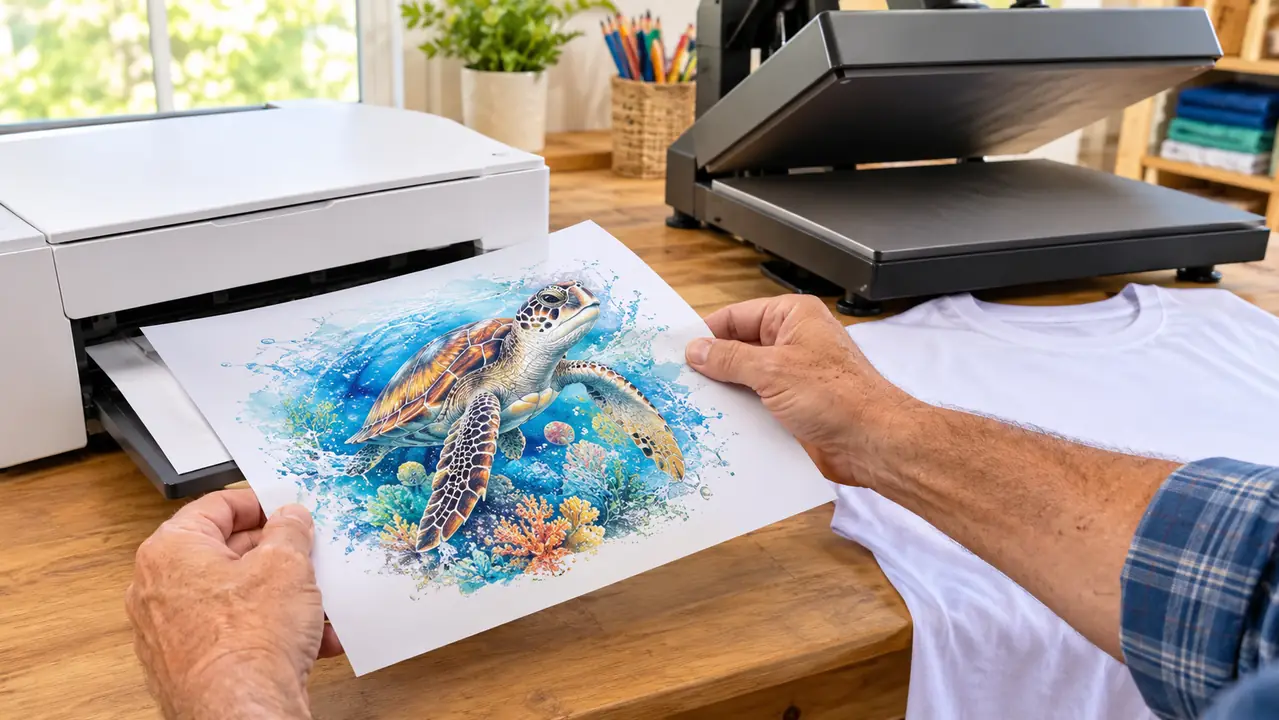
The fix was a Brother sublimation printer. It weighs 7.9 pounds and takes up roughly 20 inches of counter width, which mattered, because the press room is a converted spare bedroom and every inch of surface is spoken for. Glen carried it in from the porch and I had it set up before he came back with the second box.
Here is what a dye sublimation printer actually does, because I did not understand this at first and it cost me months. It does not print onto the shirt. It prints onto transfer paper. Then the heat press turns that ink into gas, and the gas bonds into the fibers of a polyester or poly-coated blank. What you get is not a layer sitting on top of the fabric. The design is inside the fabric. That is the whole difference, and it is the difference between a shirt a customer wears for two years and one they quietly retire to the bottom of a drawer.
The second thing that changed was the Artspira app. My designs used to live in three places at once: a folder on my laptop, a notebook, and my head. With Artspira I build the design on my tablet, import and save up to 20 printing images, send it across, and print. The touch panel and the LCD screen keep me from guessing where I am in the middle of a run, which matters more than it sounds when you have eleven shirts lined up and a booth to get to.
The first shirt I printed on the Brother has been through the wash more than forty times. The print has not cracked, peeled, or faded. The shirts from my first year are in a bag in the garage.
The machine I wish I had bought before the heat press
If you are still pressing office-printer transfers and wondering why they crack, the problem is not your technique. It is the printer. Check today's price on the one that ended six months of ruined blanks for me.
Amazon Check Today's Price on Amazon →It is not a magic box, and I would rather tell you that now than have you find out on a Friday night before a Saturday fair. The first mug I pressed came out with a pale ghost of the design floating above where it should have been, because I had the pressure wrong and the mug was not hot enough. The printer was fine. The operator was learning. Sublimation rewards you for doing the boring part: checking the time, the temperature, and the pressure on your press before you commit a blank.
The other thing worth knowing is that sublimation is a polyester game. Cotton does not take it. If a customer wants a heavy cotton tee, that is a different process and a different conversation. Knowing that up front has saved me from promising something I could not deliver, and it has also pushed me toward the blanks that work: performance shirts, poly blends, coated mugs, and the occasional tote.
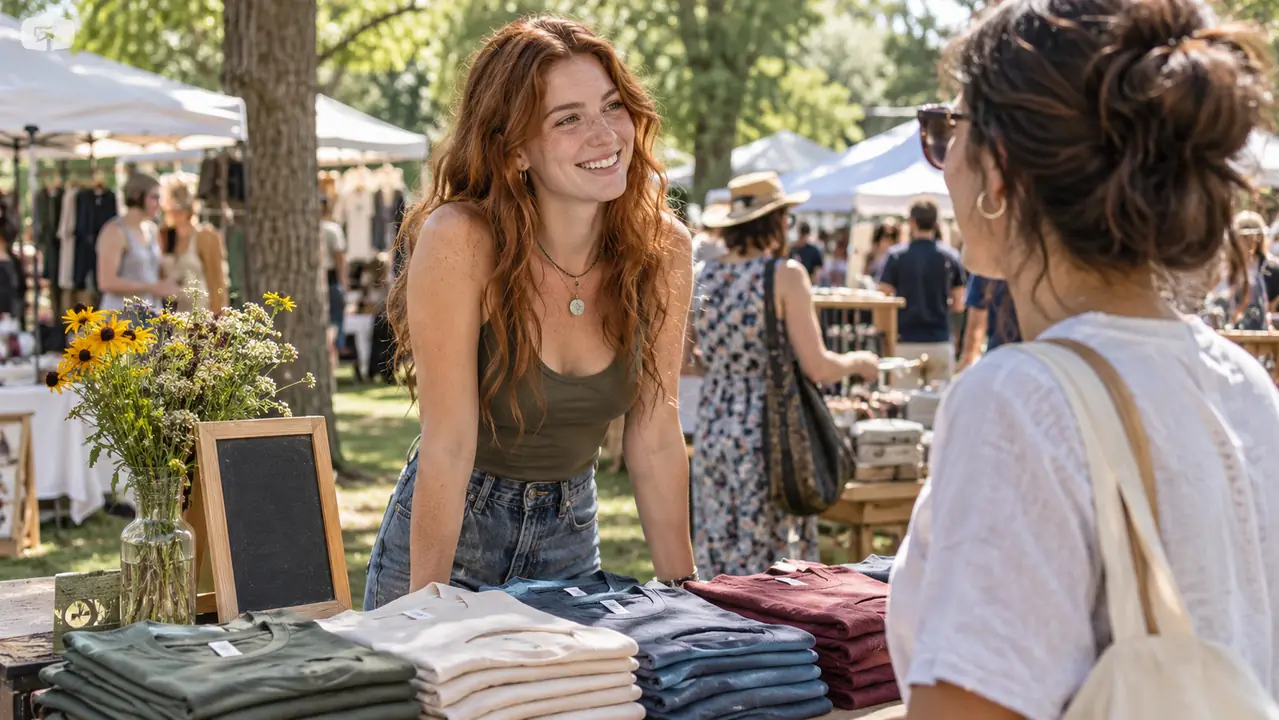
Where it paid off was the booth. Glen loads the car on Friday night and I do the rest. Because the printer is under eight pounds, it lives on the counter at home and stays there. I print the week's orders on Thursday and Friday, press them Thursday night, and stack them in a laundry basket sorted by size. By the time we are standing behind the folding table on Saturday morning, the work is done.
My favorite order this year was not a big one. A youth soccer booster club asked for thirty shirts for the parents, with the kids' names on the back in a script I had to place one at a time. Thirty backs, thirty names, all printed on the Brother and pressed in my spare bedroom over three evenings. The coach's email afterward said the parents wore them to the next away game. That is the part I did not expect when I started.
I still make mistakes. I scorched a shirt last month because I walked away from the press to answer the door. I keep a notebook now with the time and temperature for every blank I use, and I do not trust my memory anymore. The machine has been steady. My attention is the variable.
What I'd Tell You If We Were Sitting at My Kitchen Table
Start with the blanks you actually want to sell, not the machine you think you should own. Print one shirt. Wash it five times before you show it to anyone. If the design is still there, you have a product. If it is not, you have a lesson that cost you one blank instead of one customer.
And buy the right printer once. I spent six months and a lot of ruined shirts trying to make an office printer into something it was not, and the money I thought I was saving went straight into blanks I threw away. The Brother is not the cheapest way to find out whether you like sublimation. It is the way that finally let me stop fighting the equipment and start making things people wear.
Stop pressing cracked transfers. Start with a printer built for fabric.
Same heat press, same spare bedroom, same weekend fairs. The only thing I changed was the machine feeding the paper, and it changed what I could sell.
Amazon See the Brother Sublimation Printer on Amazon →