
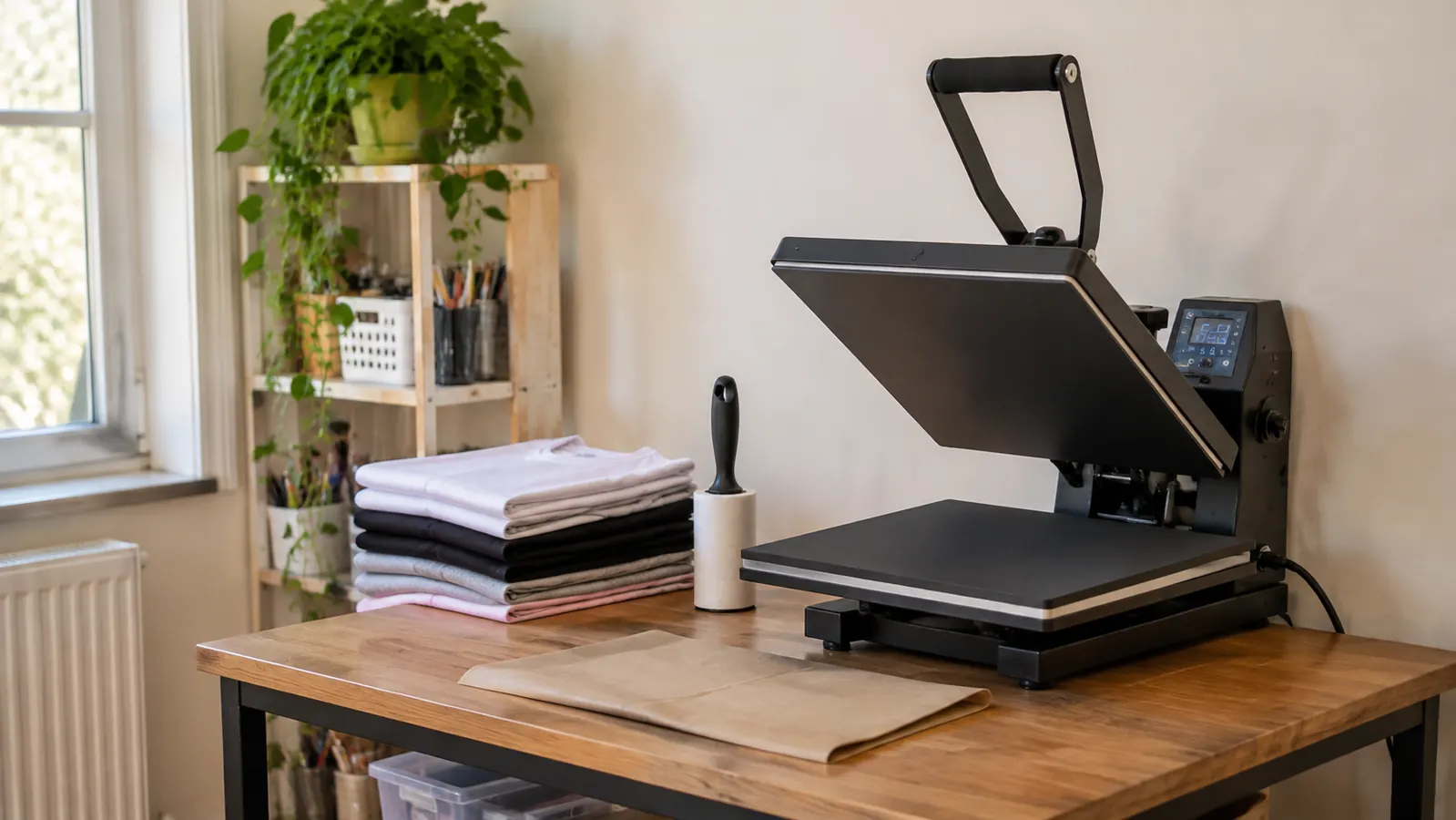
Four years ago I made matching shirts for a family reunion on a borrowed manual press, and I have not stopped pressing since. My name is Corinne Hadley, and I run a small heat press and sublimation business out of the spare bedroom in our house in Vancouver, Washington. Glen and I call it the press room. My work is weekend craft fairs, custom orders for school booster clubs and youth sports teams, and a small online shop. When I moved from a manual clamshell to the HTVRONT Auto Heat Press Machine 15x15 with Auto Release, I did it for one reason. My shoulders. What I did not expect was how much of the honest story about this machine comes down to details you will never see in a listing photo.
So this is not a piece that tells you to buy it. It is the review I wanted to read before I cleared a space on the table. There is a lot to like about the HTVRONT press and I would buy it again tomorrow. There are also four or five limits that will matter a great deal to some readers and not at all to others. If you press flat blanks, most of them will not touch you. If you press mugs, one of them will stop you cold.
The Quick Verdict
A genuinely hands-free flat press that heats evenly and lifts on its own. It is 40.3 pounds of machine that lives on one table, it will not press a mug, and the warranty runs 30 days.
Amazon Check Today's Price →The press I would buy again, with the limits above written down first
The 15x15 HTVRONT Auto Heat Press with Auto Release does the closing and the lifting for you, reaches 320 degrees Fahrenheit in about 4 minutes, and carries the flat blanks I sell every weekend. Read the spec sheet knowing the weight, the flat-only platen and the 30 day warranty, and nothing about it will surprise you later.
Amazon See the 15x15 Auto Release Press on Amazon →The 40.3 Pounds Nobody Mentions in the Photos
The spec sheet says 40.3 pounds, and that single number shapes your room more than any other line on the box. This is not a machine you carry to the kitchen table, press six shirts and put back in a cupboard. Mine sits on a solid table against the wall of the press room and has not moved since the day I set it up. If your only work surface is a folding table with a bit of flex in it, put a better table ahead of the press on your list. A wobbly table under a heavy platen is how you get crooked placements and a bad mood.
The footprint is listed at 20 inches long, 12 inches wide and 16 inches high. Length and width are only half of it, because the top plate rises when it opens. Sixteen inches of machine plus the lift means you want clear wall space above it and nothing sitting on a shelf directly overhead. I moved a set of plastic drawers three times before I stopped arguing with the room and just left the wall empty. Measure the height of the space, not only the table, before you decide where it lives.
One thing the weight does buy you is stability. A press that shifts mid-cycle will wreck an alignment faster than a wrong temperature ever will. Because this one stays exactly where I put it, I can lay a shirt, close the plate, and trust that it comes down where I left it. For a solo worker with no one to hold a corner steady, that matters more than it sounds.
How I've Used It, and What I Stopped Doing
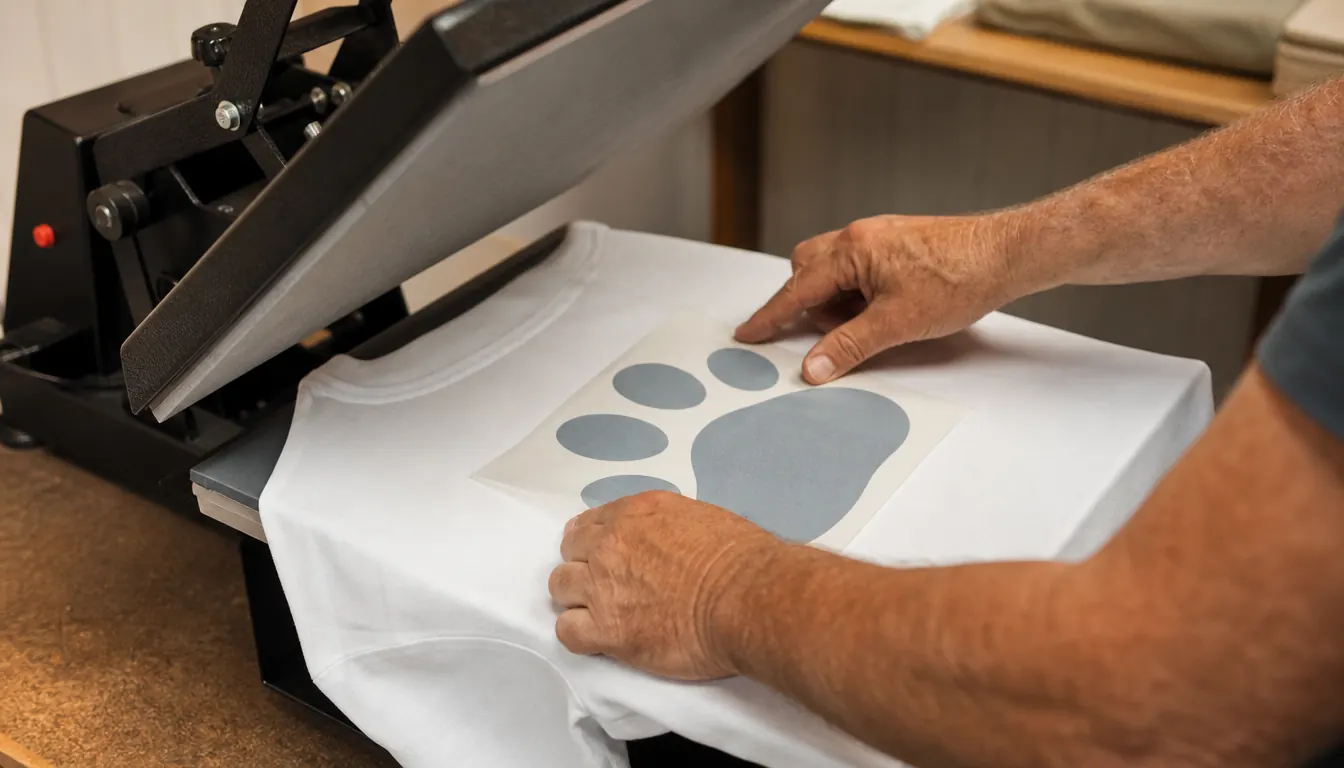
Almost everything I make is a flat blank. Cotton tees, poly blend performance shirts for the youth teams, canvas totes, tea towels, and the odd apron. My routine has not changed much from the manual days. Lint roller first, always, because a single fibre under a transfer shows up in a finished shirt like a scratch on a car door. Then layout, then a heat resistant sheet over the top, then press. What changed is the last part. On the manual press I stood over the machine and leaned my weight into the handle for every single press. On this one I set the mode, close it, and step back.
The auto release is the feature that sold me and the one I would miss most if it disappeared. The press lifts on its own when the cycle finishes. That sounds like a small convenience until you press a sublimation blank, where the ink starts moving the instant the plate touches and you cannot hover over the top to check. Standing back is not laziness. On that kind of blank it is the only way to get a clean, even result, because hovering and lifting early is exactly how you get a half transferred image you have to throw away.
Heat up is quick enough that it does not shape my morning. HTVRONT rates the 15x15 plate to reach a common use temperature of 320 degrees Fahrenheit, or 160 Celsius, in about 4 minutes, and mine lands in that neighbourhood. I use those four minutes to lint roll and fold, so the machine is usually ready around the same time I am. That is a small thing that adds up over a season of Saturday mornings.
Let me give you a real morning. Last October I had a booster club order of thirty-two shirts for a middle school volleyball team, all the same design, two colorways. I laid them out in a stack on the floor in the order I wanted to press them, which is a habit I picked up from a quilter. Fold, lint roll, lay, press, pull, fold again. With the auto press doing the closing I could fold the shirt I had just finished while the next one was under the plate. Thirty-two shirts took me a little over two hours, including a coffee break, and every single one came off the plate at the same pressure because I was not the one applying it by the twenty-fifth shirt. On the manual press that same order would have taken me closer to three and a half hours, and my last ten shirts would have been my worst ten. That is the honest case for the machine in one paragraph.
The Modes, and the Ones I Actually Touch
The machine carries 4 fast modes, 2 custom modes and an auto mode. Here is the honest breakdown after living with it. The fast modes are starting points. They are genuinely useful in the first month, when you are pressing a lot of different blanks and do not yet know what each one wants from you. The auto mode is the one that does the hands-free work, and it is where most of my pressing happens now, because it is the mode that lets me walk away mid-cycle without the result suffering.
The 2 custom modes are the part I underrated at the start. Once you find the settings a particular blank likes, saving them means you are not re-entering anything on the fourth shirt of a team order. I have one saved for the poly blend team shirts and one for canvas totes. That is the entire system in my press room. Boring, repeatable, and it has taken a good deal of second-guessing out of a forty shirt run, which is worth more to me than any extra feature someone could bolt on.
The first week I owned it, I pressed a set of poly blend team shirts on one of the fast modes without writing anything down. They came out fine. Two weeks later I could not remember which mode I had used, pressed the next batch on a different one, and got a transfer that lifted at the shoulder seam on two of the eight. Nothing was wrong with the press. I had simply treated a setting as a mood instead of a number. That is what pushed me into the custom modes, and it is the single habit change I would hand to anyone starting out. Write the setting on the inside of the shirt order bag with a marker. Future you will be grateful.
What the Temperature Range Really Covers
HTVRONT lists the working range at 160 to 210 Celsius, which is 320 to 410 Fahrenheit. For the work I do, that range is the whole map. Standard heat transfer vinyl, poly blends, canvas and the sublimation blanks I run all sit comfortably inside it. If your plans need temperatures above 410 Fahrenheit, this press is not the one, and I would rather you hear that from me now than discover it on a blank you have already printed and cut.
The other half of temperature is consistency, and this is where an auto press earns its keep. A manual press gives you whatever motion your arms give it on that particular afternoon, and by shirt thirty your arms are tired and the results drift. The HTVRONT does the closing and the lifting the same way every cycle, which means the fifth shirt in a batch looks like the first. On team orders, that repeatability matters more than any single line on the feature list.

The Limits I Would Want to Know About
First, the warranty description runs 30 days. I will say that plainly because it surprised me. Thirty days is short for a 40 pound machine, and it means the first month is your real testing window. Press everything you plan to press, on the blanks you actually sell, while the coverage is live. Keep the box. If something is going to be wrong with a machine, you want to find out in week two rather than week nine.
Here is why I care about that so much. On my old manual press the heating element went soft in month seven. Nothing dramatic, no smoke, no bang. It just stopped getting all the way to temperature, so vinyl started needing a second press and I blamed my own technique for three weeks before I thought to check the plate with an infrared thermometer. By then the useful coverage was long gone and I paid for the replacement element myself. That experience is why I now treat the first thirty days with a new machine as a job in itself. I run a full temperature check, press one of every blank I actually sell, and keep a note of what happened. It costs me an afternoon. It has saved me a month of doubt.
Second, this is a flat press. It presses flat things. Shirts, tote bags, tea towels, aprons, flat sublimation blanks. It will not press a mug, a tumbler or a hat for you, and nothing about the 15x15 platen changes that. When people ask me about mugs, I give them the same answer every time. Mugs are a different tool. If mug work is the centre of your plan, this press is one piece of a larger setup, not the setup by itself.
Third, it is a 120 volt machine, which is what you want in a US home but worth checking if you are reading this from somewhere else. Fourth, the weight and the footprint are a real commitment of table space, not a detail. Fifth, 30 days of coverage puts the support question on your desk sooner than you would like. None of these are deal breakers for me. All of them are things I would want named out loud before I handed over a card.
Where It Honestly Beats My Old Manual Press
I am not going to pretend the manual press was bad. It made my little business possible for years and I still keep it for small jobs where I want to feel the pressure through my hands. But three things changed for the better. The first is my shoulders, and by Sunday night after a fair that is not a small thing. The second is repeatability across a batch, because the machine is not getting tired on shirt thirty-five the way I was. The third is the auto release on sublimation, which I have already gone on about and will not apologize for.
There is one more difference I did not expect, and that is how the work feels. Leaning into a handle for four hours is physical labour, and by the end of a fair day I used to have nothing left for the conversation that actually sells a shirt. Now I can stand at the front of the booth and talk to people while the machine works behind me. I sell better when I am not tired. That sounds like a soft benefit until you have watched a customer walk away because you were too worn out to answer a question about sizing. The press gave me back the part of the job I am actually good at.
What I Liked
- Auto release lifts on its own, so sublimation blanks get a clean result without you hovering over the plate
- Reaches 320 degrees Fahrenheit in about 4 minutes, which fits neatly into your layout time
- 2 custom modes let you save settings for the blanks you press most, so batch work stays consistent
- 40.3 pounds of machine that does not shift mid-cycle, which protects your placement
- 15x15 platen handles adult tees, totes and tea towels with room to spare
Where It Falls Short
- Warranty description is 30 days, so your real testing window is short
- Flat work only. No mug, tumbler or hat pressing
- 40.3 pounds and 16 inches of height mean a permanent table and clear wall space
- Top of the range is 210 Celsius, or 410 Fahrenheit, and some blanks want more
- 120 volts, so it is built for a US outlet
The press lifts itself. On a sublimation blank, where you cannot hover and check, that single motion is the difference between a clean edge and an image you have to throw in the scrap bin.
Who This Is For
This press suits someone who already knows they will run a steady volume of flat blanks and who wants the machine to do the lifting. That means a craft fair seller doing shirts and totes most weekends, a parent running team shirts for a booster club, and anyone who has put a season on a manual press and felt it in their wrists by Sunday night. It also suits people who work alone, because auto release means you are not chained to a handle at the exact second a cycle ends. If you have a dedicated table, a wall with a bit of clearance, and a steady stream of flat work, the HTVRONT fits that life well.
Who Should Skip It
Skip it if mugs and tumblers are the centre of what you sell. Skip it if your only surface is something you have to clear away every evening, because 40.3 pounds does not want to be lifted twice a day. Skip it if your blanks need more than 410 Fahrenheit. And skip it if a 30 day warranty would sit in the back of your mind every time you closed the plate, because that is a fair reason to look at a machine with a longer one. None of that makes the HTVRONT a bad press. It makes it the wrong press for a particular job, and knowing which job you have is most of the decision.
If the limits did not scare you off, this is the flat press to look at
Hands-free closing, auto release, 4 fast modes, 2 custom modes and an auto mode, with a 15x15 platen that covers adult tees and totes. It is a permanent-table machine for people who press flat blanks all season. If that is you, the spec sheet is worth ten minutes of your evening.
Amazon Check Stock and Details on Amazon →