
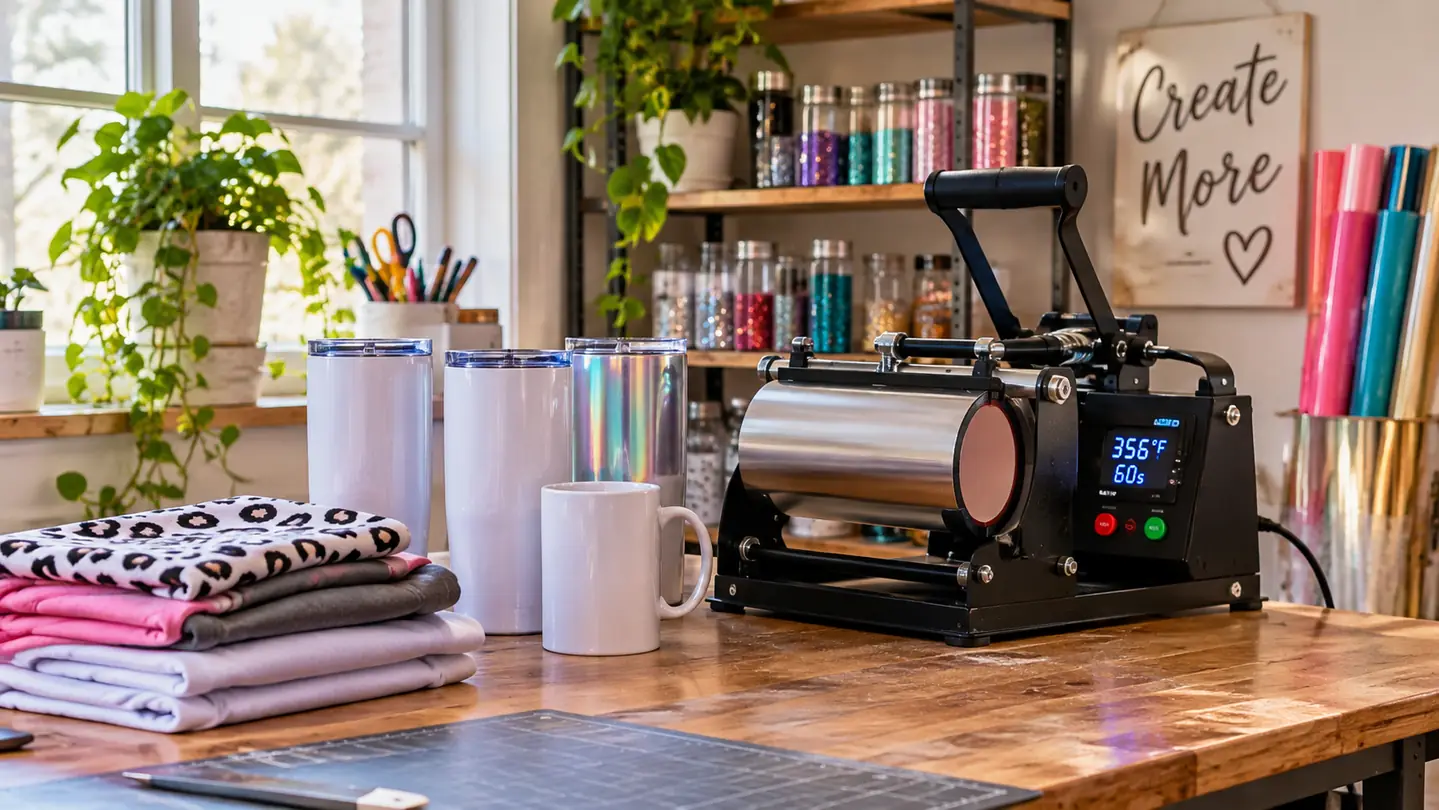
The first thing I noticed about the HTVRONT Auto Tumbler Heat Press was not the box. It was the footprint. I run a small heat press and sublimation business out of a converted spare bedroom in Vancouver, Washington, and every new tool has to earn its counter space. I make custom drinkware for weekend craft fairs, school booster clubs, and a few youth sports teams. My press room already had a shirt press, a mug press, and a shelf of blanks waiting for orders. The HTVRONT arrived as a compact unit, 12.9 by 10.9 by 6.3 inches, and I could set it on the same table where I wrap tumblers by hand. That mattered. The machine did not need a second room, a second table, or a new routine. It needed a clear space and a test blank.
This is an honest review, not a victory lap. I have used the HTVRONT long enough to know where it helps and where it makes me slow down. The short version is that it removes the repetitive hand-wrapping step for drinkware in its size range, and it does that well. The longer version is that it is still a heat press. It still needs test blanks, a clean workspace, and an operator who pays attention. If you want a machine that makes custom tumblers foolproof, this is not that machine. If you want one that takes over the tiring part of a repeatable process, keep reading.
The Quick Verdict
A compact auto tumbler press that earns its space for repeat drinkware orders, as long as your blanks fall inside the 2.9 to 3.2 inch fit window.
Amazon Check Today's Price →The Fit Check Comes Before the Checkout
Measure the tumblers you actually sell, then compare them with the 2.9 to 3.2 inch diameter and 10 to 30 ounce range. If they fit, this is the press I reach for on batch days.
Amazon Check Current Price on Amazon →What the Listing Does Not Tell You
The listing gives you the headline numbers: 600 watts, 120 volts, a 4.92 kg body, and a temperature range of 210 °F to 390 °F. Those are useful. They are not the whole story. The number that decides whether this press fits your work is the drinkware range. HTVRONT says 2.9 to 3.2 inches in diameter and 280 to 850 milliliters, which is 10 to 30 ounces. That is a generous window for the tumblers I sell, but it is not every tumbler on the market. Skinny tumblers, oversized bottles, and some tapered cups fall outside it. I measured a stack of blanks before I placed my first order, and I am glad I did. A press that cannot grip your blank is just a very sturdy paperweight.
The second thing the listing does not tell you is how much the auto cycle changes your body. Wrapping a tumbler by hand is not hard, but doing it twenty times in a row is tiring. The pressing, smoothing, taping, and checking add up. The HTVRONT has an auto pressing function that takes over the repetitive part after a simple click. That sounds like a small convenience. In a real batch, it is the difference between finishing the last tumbler with steady hands and rushing the final few because my wrists are done. I still check every wrap before the press closes. I just do not have to stand there and hold the pressure myself.
The listing also says the press is recommended for sublimation printing on drinkware such as tumblers, mugs, water bottles, and similar items. I use it for tumblers and a few straight water bottles that sit inside the stated range. I have not tried every mug in my cabinet, because a mug that is too wide or too narrow will not be held properly. That is not a knock on the machine. It is a reminder to read the fit numbers before you plan a project. The HTVRONT is at its best when the blank is close to the size it was designed for. A loose fit does not give you a clean transfer, no matter how carefully you tape the design.
How I've Used It in the Press Room
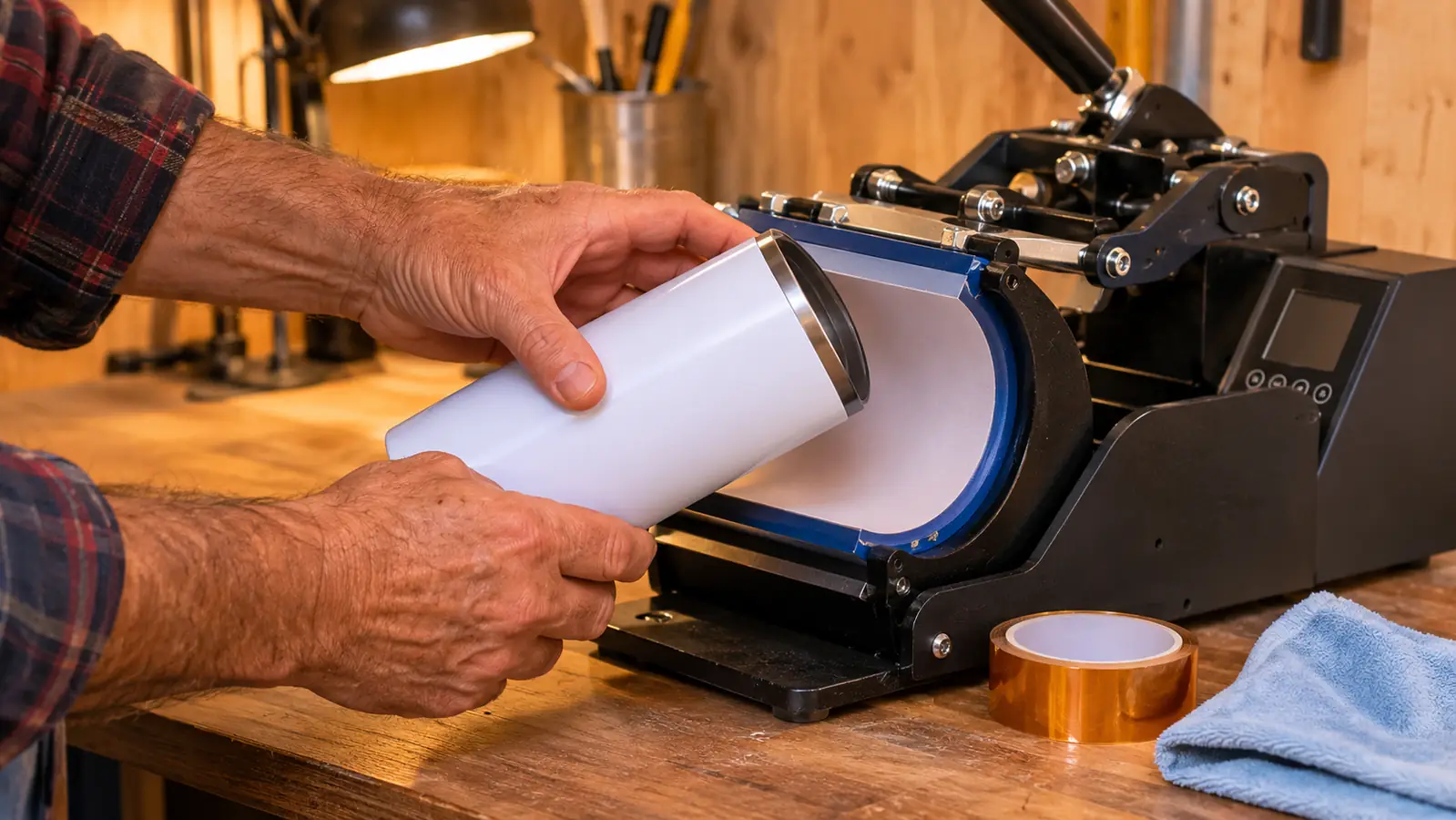
I set the HTVRONT on the left side of my worktable, next to the cutting mat and a small stack of lint-free cloths. My routine is simple. I print the design, let it dry, wipe the tumbler, wrap the transfer, tape the seam, and load the blank. The machine handles the heat and the hold. I use it most for school booster club orders, where a parent asks for twenty tumblers with the same logo. Those orders used to eat an entire evening. Now I can run a batch while I answer emails, as long as I stay close enough to hear the cycle finish. I do not leave the room. A heat press is not a slow cooker.
Glen helps me load the car for weekend craft fairs, and he has a good eye for what sells on a table. He noticed that the tumblers made with the HTVRONT had a more even finish around the seam than the ones I wrapped by hand in my early days. That is not because the machine is doing anything mysterious. It is because the heat pad holds the blank consistently while the cycle runs. My hand-wrapped tumblers were good, but they depended on how tired I was. The press does not get tired. That consistency is what customers notice, even if they cannot name it.
I also use it for personal projects, which is how I learn a machine's limits. I made a set of tumblers for a family reunion, the same kind of project that got me started four years ago. I tried a tapered cup that was slightly outside the range. The press did not hold it the way I wanted, and I ended up wrapping that one by hand. That was not a defect. It was a fit problem. The HTVRONT is honest about its range if you read the specs. The trouble is that many of us buy first and measure later. I know I have.
The other lesson from craft fair season is that setup time matters as much as press time. At a weekend fair, I am often finishing a few custom orders the night before. The HTVRONT warms up while I trim transfers and match lids to cups. I keep a short checklist taped to the table: check the blank size, wipe the surface, tape the seam, load the press, confirm the cycle. That checklist has saved me from rushing. The machine makes the pressing part easier, but the checklist makes the whole batch more reliable. I would rather spend five extra minutes on the front end than explain a crooked logo to a customer.
The press does not get tired. That consistency is what customers notice, even if they cannot name it.
The Auto Feature: Helpful, Not Foolproof
The auto feature is the reason I chose this model over a manual tumbler press. It runs the cycle without me holding the pressure. The R button is the part I had to learn. Press R and the machine halts heating and releases the heat pad instantly. The first time I used it, I hit R at the end of a cycle and stepped back too quickly. The pad released faster than I expected. Nothing was ruined, but I learned to keep my hands clear and my workspace tidy. That button is a safety feature and a rhythm changer. It is not a pause button for a coffee break.
I tested the auto cycle with three blank styles I use often: a straight 20 ounce tumbler, a slightly wider 30 ounce tumbler, and a shorter cup that sits near the bottom of the size range. All three fit, and all three came out with even coverage after I dialed in the time. The shorter cup needed less time. That is not a machine flaw. It is how heat works. The HTVRONT gives you a range from 210 °F to 390 °F, and you still have to match the temperature and time to the blank, the transfer, and the room. The auto feature removes the repetitive motion. It does not remove the need to test.
Where the auto feature helps most is in repeatability. When I find a setting that works for a particular tumbler, I write it on an index card and tape it inside a cabinet door. The next time that blank shows up, I can run the same cycle and expect a similar result. That sounds boring. Boring is good when a customer is waiting on an order. The press lets me be boring in the best way. It also makes it easier to show Glen how to run a simple batch, which is a nice bonus when a craft fair is two days away and the car is not packed yet.
I still keep a phone timer nearby as a backup, mostly because I do not trust myself to remember where I am in a batch when the doorbell rings. The machine runs its cycle, but my attention is the part that wanders. That is not a product problem. It is a workshop problem. The HTVRONT makes the pressing consistent, and my job is to keep the blanks, transfers, and customer names in the right order. On a good day, the two things work together. On a busy day, the phone timer and the checklist keep me honest.
Fit Matters More Than the Wattage
People ask about wattage first. The HTVRONT is 600 watts at 120 volts, which is fine for a home outlet in my press room. I have not tripped a breaker, and I run it alongside a small printer and a laptop. The wattage is not the number that limits my work. Fit is. The press accommodates drinkware from 2.9 to 3.2 inches in diameter and 280 to 850 milliliters. If your best-selling tumbler is outside that window, the machine will not do the job no matter how many settings you try. I keep a cheap caliper in my drawer now. It takes ten seconds to check a new blank, and it saves me from a bad batch.
The ABS shell is another detail that matters more than it sounds. My press room gets dusty from vinyl scraps and cardboard boxes. The shell wipes down with a damp cloth, and the unit is light enough at 4.92 kg that I can move it to the center of the table when I need more room. I do not move it often. I set it once and built the workflow around it. That is the better approach. A heat press should live where you can use it without rearranging the room every time. The HTVRONT is small enough for a spare bedroom and solid enough that it does not wander when I press the R button.
If your orders are mostly straight 20 ounce tumblers, this press lands in a sweet spot. That size is common for school teams, small businesses, and family gifts, and it sits comfortably inside the stated range. I can load one after another without adjusting the press between blanks. When a customer brings me a wider 30 ounce tumbler, I check the diameter first and then run a test. The press handles it, but I do not assume. The difference between a smooth batch and a frustrating one is often a measurement I took before the first transfer went on.
Heat, Time, and the Test Blank Rule
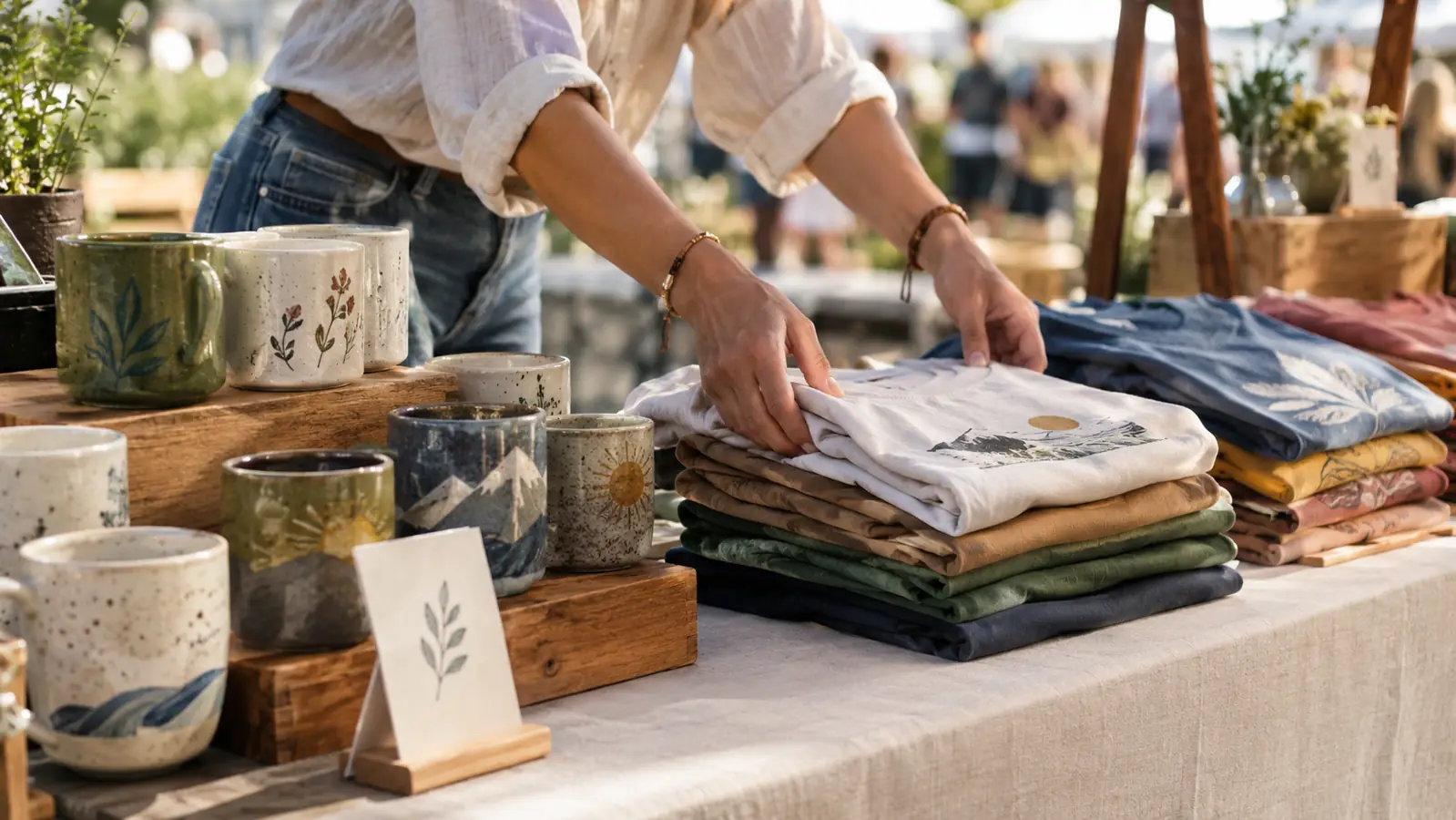
The hardest lesson I learned with any heat press is that a test blank is not wasted material. It is the cheapest insurance you can buy. I keep a few reject tumblers under the table for exactly this purpose. When a new blank arrives, I run one with a simple design and a scrap transfer. I check the seam, the edges, and the overall evenness before I commit a customer's order. The HTVRONT made that habit easier because the auto cycle gives me a repeatable baseline. I can change one variable at a time and see what happens. That is how I found the setting for the shorter cup. It is also how I avoided a scorched batch when I switched to a thinner transfer.
Temperature is the other variable that demands respect. The machine can run from 210 °F to 390 °F. That is a wide range, and it covers the work I do, but it also means you can get into trouble quickly if you guess. I start on the lower end for thin transfers and work up only when the test blank tells me to. I never adjust the temperature in the middle of a customer's batch unless I have already tested the change. The HTVRONT heats consistently, which makes those tests useful. A machine that runs hot and cold would make every batch a coin flip. I do not have time for coin flips, and neither does a customer waiting on a team order.
The one-year warranty is worth mentioning because it sets a realistic expectation. This is a tool, not a lifetime purchase. I treat it like a tool. I keep it clean, I do not force a blank that does not fit, and I give it room to breathe on the table. If something goes wrong, I want the warranty to be a backup, not a plan. That attitude has served me well with every press in my room. The HTVRONT has been reliable so far. I still keep my old manual press within reach for the blanks that fall outside the range. A good workflow has a backup, even when the main tool is working.
I also keep a small notebook with the date, the blank size, the transfer type, the temperature, and the result. It is not a fancy system. It is a record that keeps me from repeating a mistake I already made. The first batch I ran on the HTVRONT was a set of straight tumblers for a youth sports team. I was so pleased with the even finish that I almost skipped the notebook for the next order. Then a different blank arrived, and I had to start from scratch. Now the notebook is part of the process, just like the test blank. The press rewards that habit.
What I Liked
- Fits drinkware from 2.9 to 3.2 inches in diameter and 10 to 30 ounces, which covers the tumblers I sell most.
- The auto cycle takes over the repetitive pressing, so batch days are easier on my hands.
- The R button releases the heat pad instantly, which is useful at the end of a cycle.
- Compact footprint at 12.9 by 10.9 by 6.3 inches, so it fits a small press room.
- Backed by a one-year warranty.
Where It Falls Short
- Does not fit skinny tumblers, oversized bottles, or tapered cups outside the stated range.
- You still need test blanks and a record of time and temperature for each style.
- The R button release is fast enough that you need a clear workspace and a steady hand.
- It is a single-purpose tool, so it earns its space only if drinkware is a real part of your work.
Who This Is For
The HTVRONT Auto Tumbler Heat Press is for someone who already sells or regularly makes drinkware in the 10 to 30 ounce range and wants to stop hand-wrapping every blank. It suits a small press room, a craft fair table, a school booster club order, or a youth sports team that needs a consistent set of tumblers. It also suits a maker who values repeatability over novelty. If you are willing to test blanks and keep notes, this press will reward that discipline. It is not a shortcut around learning your materials. It is a way to remove the repetitive motion so you can focus on the part that needs judgment.
Who Should Skip It
Skip it if your work depends on skinny tumblers, oversized bottles, or tapered cups outside the 2.9 to 3.2 inch diameter range. Skip it if you only make a tumbler once a month and already have a manual method that works. Skip it if you want a machine that guarantees a perfect result without test blanks, because no press does that. And skip it if you are not ready to keep a clean, clear workspace around a heat pad that releases quickly. The HTVRONT is a good tool for a specific job. It is not a universal answer, and I would rather tell you that now than have you find out after a wasted blank.
Measure Your Blanks, Then Decide
If your drinkware fits the 2.9 to 3.2 inch diameter and 10 to 30 ounce range, the HTVRONT Auto Tumbler Heat Press is the tool I would put on a batch table. Check the current listing, confirm the fit, and keep one test blank ready before the first customer order.
Amazon Check Current Price on Amazon →